
When I first transitioned into serious multi-day trekking, finding the right backpack was arguably the most critical gear decision I had to make. I needed a pack that could survive its inaugural test on the gruelling Annapurna Circuit in Nepal, while also serving as a long-term investment for years of future mountain expeditions. After all, the entire ethos of Backpacker’s Mentality relies on having a reliable rucksack to carry your life in—making it the single most important piece of kit for trekkers, hikers, and backpackers alike. And why not start my search with the iconic Osprey Atmos AG 50 Backpack?
Navigating the market can be overwhelming, as every outdoor equipment company sells a dizzying array of backpacking rucksacks with different volumes, suspension systems, and selling points. Based on my research, my criteria were strict: I wanted a 45L to 60L capacity to force me to pack smart, and a budget of under £200. Having trusted Osprey for daypacks in the past, they were my natural starting point. However, I rigorously compared all the big brands and premium options before ultimately making my choice: the Osprey Atmos AG 50. Read on for the full review to see exactly how it performs on the trail.
Field Note: This guide contains affiliate links. If you purchase gear through these links, I may earn a small commission at no extra cost to you. I only recommend equipment I have personally mountain-tested and trust.

Introducing: Osprey Atmos AG 50
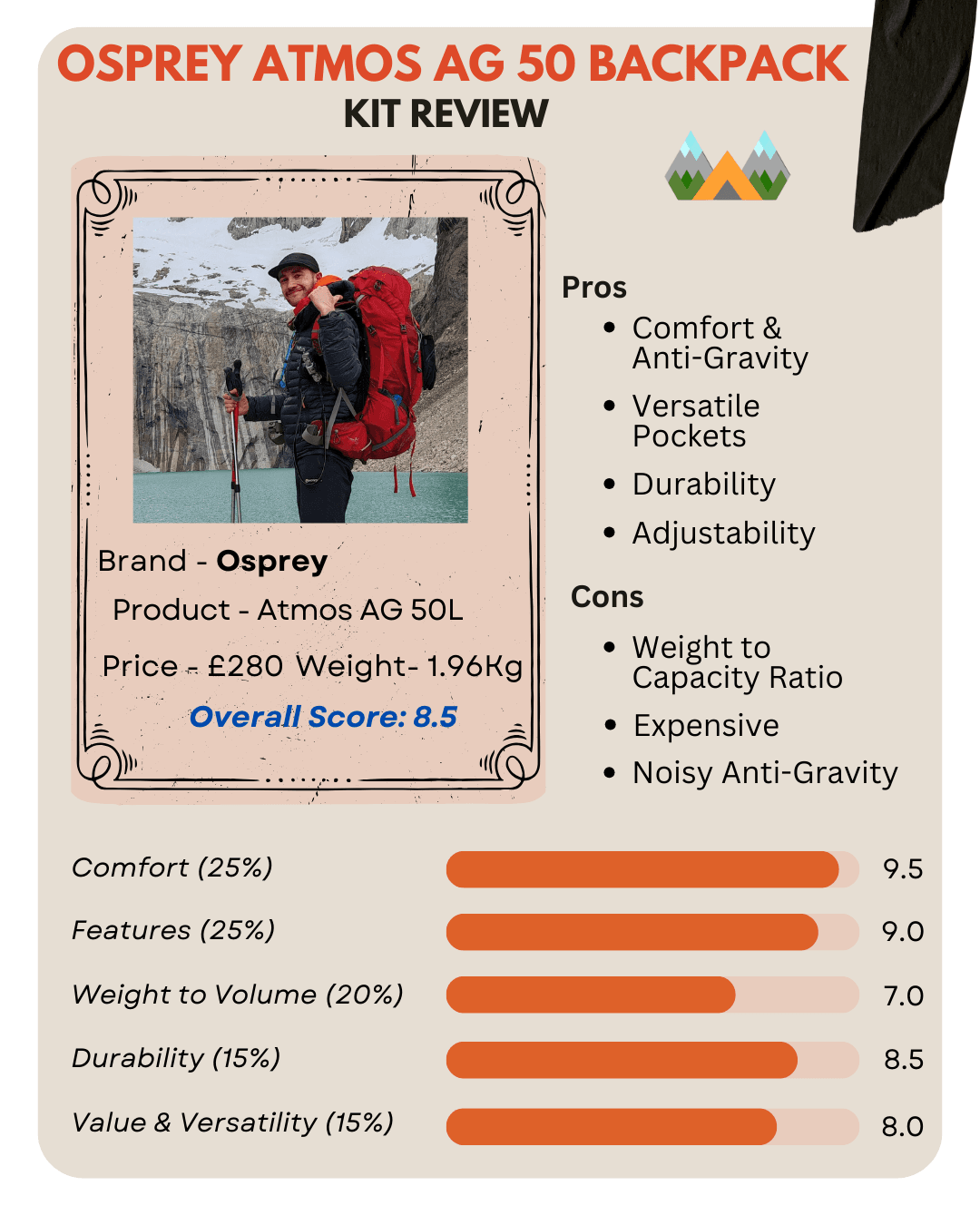
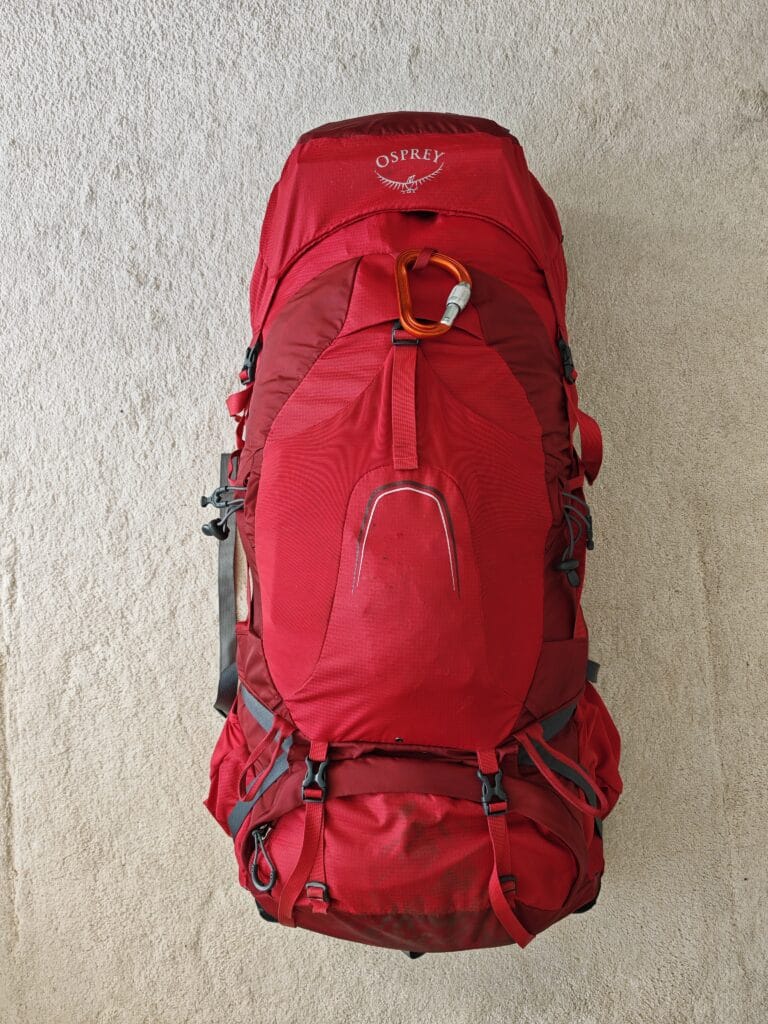
After much research, I chose the Osprey Atmos AG 50 (buy here) because of the class-leading comfort and all-around capability thanks to the Anti-Gravity (AG) suspension and features. This model is a best-seller among backpackers, and the latest model proves as desirable as ever. I was lucky enough to find the Red Osprey Atmos AG 50 on sale for a bargain £125 down from £280! This helped my decision between the Atmos 50 instead of the Osprey Kestrel 58L or the Osprey Exos 48.
The fantastic ventilation, removable lid and amount of adjustable storage were some of the key selling points. The Osprey Atmos 50 is one of the best all-around trekking backpacks, and you can’t go wrong with this pick! I bought the 2021 model, whereas the new 2022 version has additional side zips for more storage. See below for a comparison to the newer 2025 Women’s version and what improvements Osprey have implemented.
Osprey Atmos AG 50
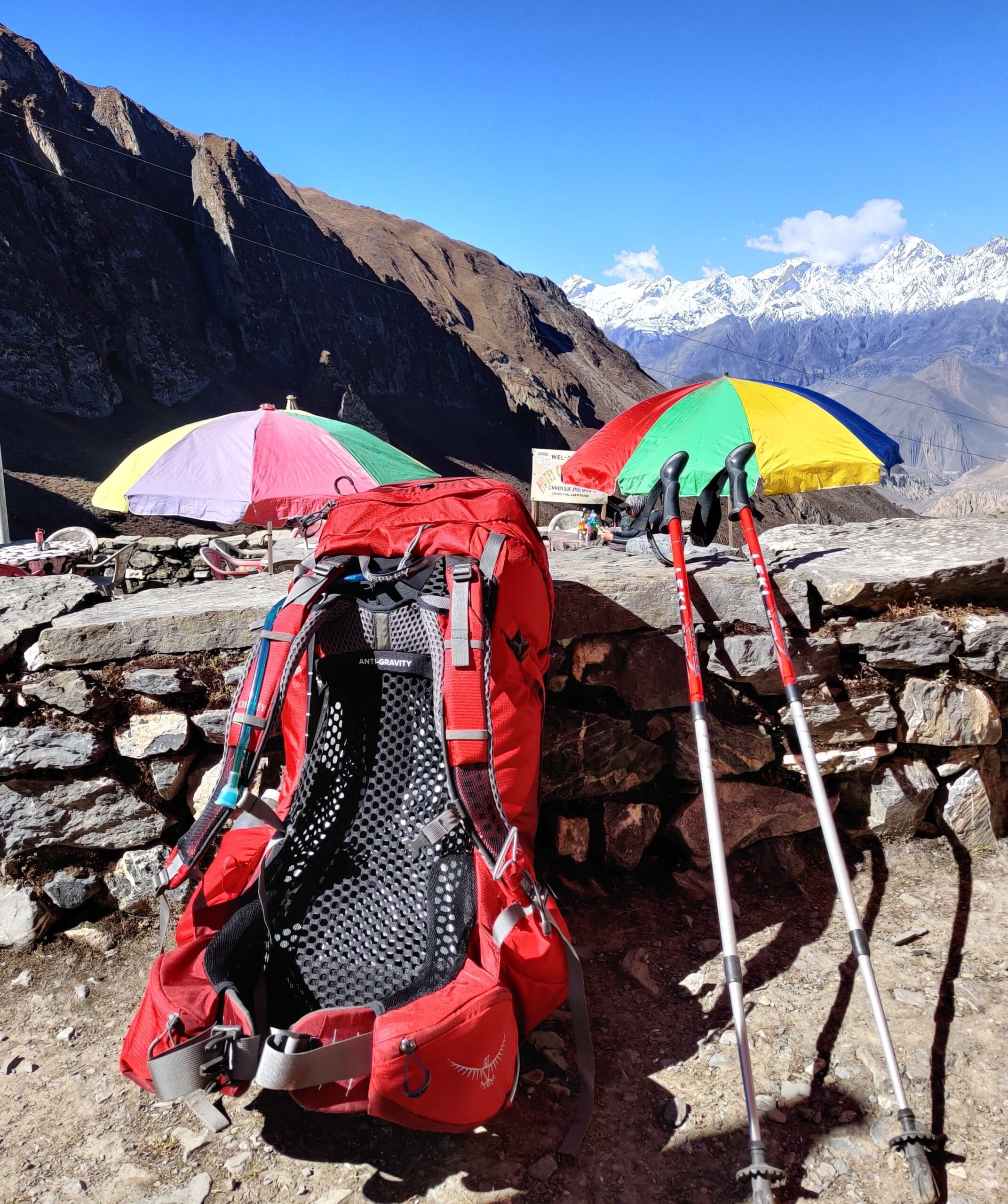
The Osprey Atmos AG 50L is a classic design for trekking backpacks with top-loading access. Osprey offers 2 variants, the Atmos for Men and the Aura for Women, in 50L or 65L options for both. I chose the 50L option as I prefer to travel minimally and light. My friend Sam has the Atmos AG 65, and we’ve used both Atmos on camping trips and Dolomite Treks. The Osprey Atmos 50 has become the backbone of my Ultimate Trekking List and has never failed me so far.
The Osprey Atmos AG 50 is offered in S/M and X/XL sizes, so check which fits your body best before buying! You can now buy the Osprey Atmos AG 50 in Black, Mythical Green or Venturi Blue. The Osprey has the Atmos LT (£235), which is a streamlined and lighter version designed for technical backpacking.
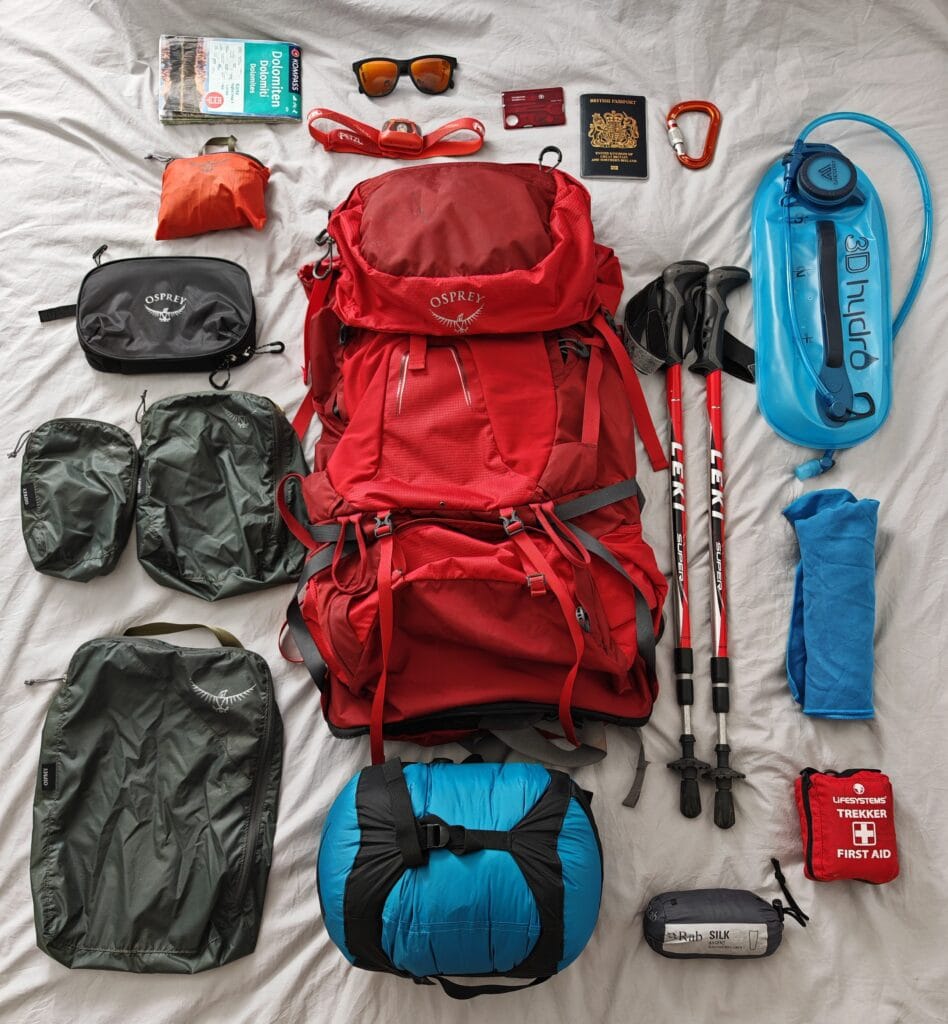
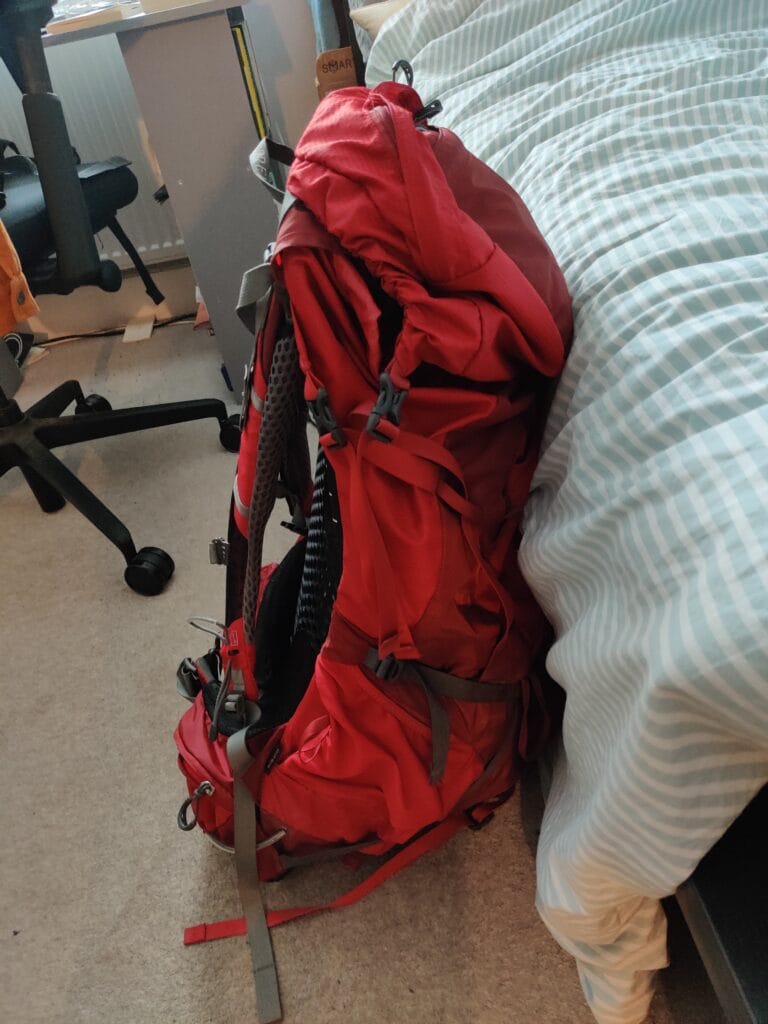
Osprey Atmos AG 50: Key Features
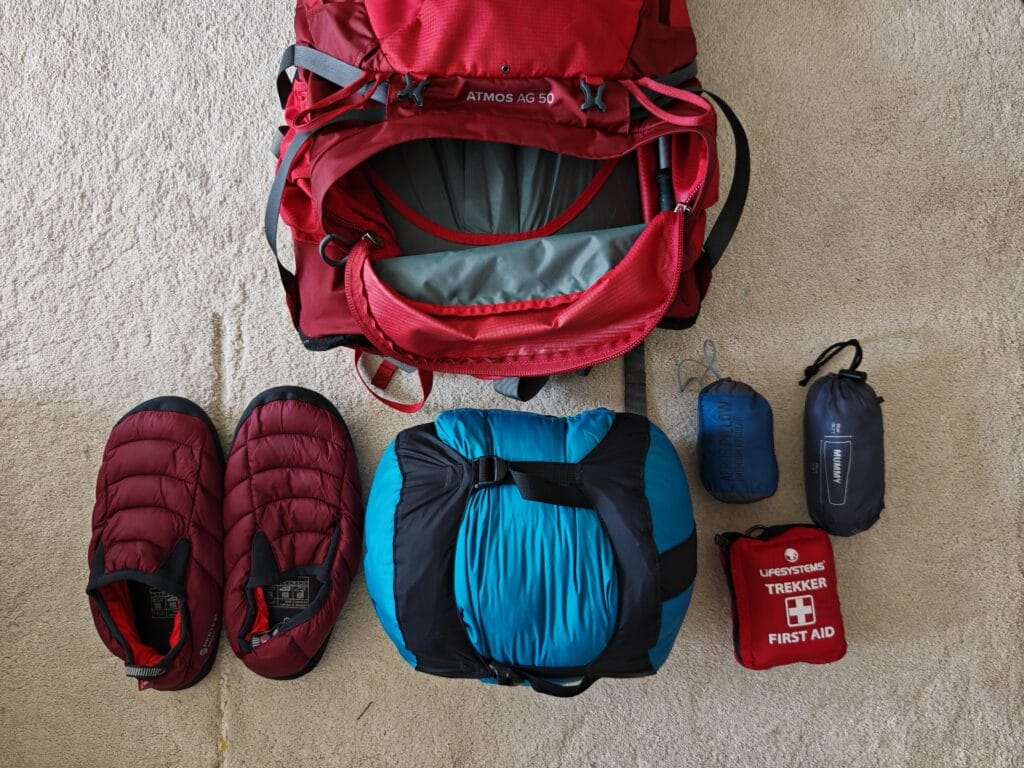
- DWR rain cover– The neon rain cover provides great water protection and packs into the lid-zipped pocket.
- Floating top lid – The detachable lid is a handy feature for lighter-day hiking and clips in easily on the back.
- Fabric-reinforced front shove-it pocket – The elasticated Kangaroo pocket is one of my favourite features and is handy for storing snacks, food and even jackets.
- Tall dual-access side water bottle pockets – The two-sided pockets allow easy access to water bottles when on the trail, with one per side.
- Dual upper/lower side compression straps – The combination of adjustable straps allows flexibility and stability.
- Dual-zippered hip belt pockets – Some people criticise the size of these; however, they fit phones, wallets, snacks and quick-to-get items with a good-sized zip.
- Dual ice axe loops – The loops secure trekking poles effectively, but I can not comment on the ice axe attachment.
- Zippered sleeping bag compartment – A great feature when on a trek is to keep all the sleeping equipment in a divided compartment.
- Removable sleeping pad straps – Since using an inflatable sleeping pad, I haven’t attached a roll mat yet
- Internal hydration reservoir sleeve – A large-sized bladder sleeve to fit up to 3L, but one annoyance is the metal bar to push past when loading it in and going to refill. The bladder hose loops are useful on the shoulder straps.
- Stow-on-the-Go trekking pole attachment system – An Osprey feature I’ve only used in Nepal that works consistently and doesn’t impact arm swing.
Osprey Atmos vs Aura
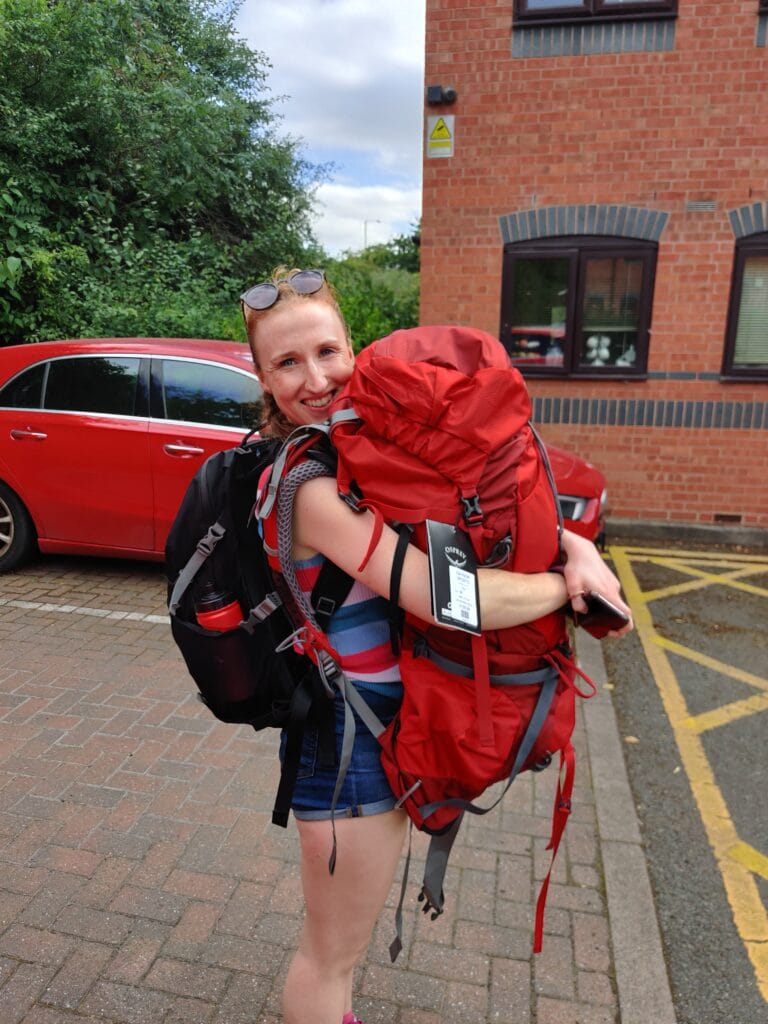
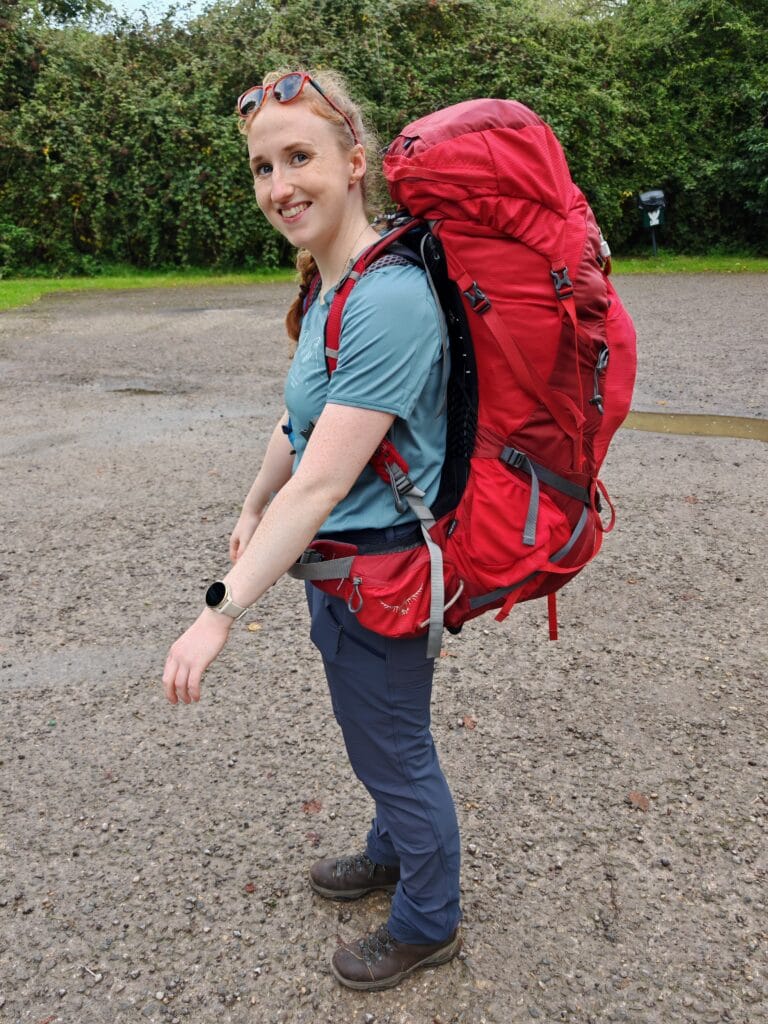
Since I primarily use the men’s Osprey Atmos AG 50 and my partner carries the women’s Aura AG 50, we get to see the exact structural differences side-by-side on the trail. Osprey didn’t just shrink the men’s bag and change the colours; the Aura is a meticulously engineered women ‘s-specific fit.
- The Shoulder Harness: The Aura features a completely different angle and contoured padding designed to sit comfortably across the chest without chafing the neck or shoulders.
- The Hipbelt: The waist belt is noticeably narrower in height to prevent the stiff padding from jabbing into the lower ribs. It also features a more pronounced, conical angle to properly cup a woman’s hips, ensuring heavy gear weight transfers efficiently to the legs.
- The Profile: The overall shape of the Aura is slightly narrower and deeper, keeping the centre of gravity perfectly balanced for a typically shorter torso.


What’s New in the 2025 Version?
Comparing my older 2022 generation of the Osprey Atmos AG 50 to her brand-new 2025 Aura has highlighted some massive quality-of-life updates that Osprey recently introduced to the entire AG line. If you are buying the newest version today, here is the upgraded hardware you can expect:
- Curved Side-Access Zips: You no longer have to unpack the entire bag from the top just to reach a buried fleece mid-layer. The new, heavy-duty curved side zippers grant instant access to the main compartment.
- A Quieter Backpanel: The older Anti-Gravity suspension occasionally suffered from an annoying “creaking” sound when walking with a heavy load. The newer mesh and frame integration is wonderfully silent on the trail.
- Taller Water Bottle Pockets: The stretch-mesh side pockets have been redesigned to sit higher and tighter, finally preventing large Nalgene bottles from falling out when bending over to scramble up rocks.
- Eco-Friendly Materials: The entire pack is now constructed with 100% recycled, bluesign®-approved 210D high-tenacity nylon and features a much safer, environmentally friendly PFAS-free durable water-repellent finish.
- Relocated Raincover: The integrated raincover has been moved from the lid to its own dedicated bottom pocket, making it significantly faster to deploy without taking off the pack when a sudden mountain storm hits.

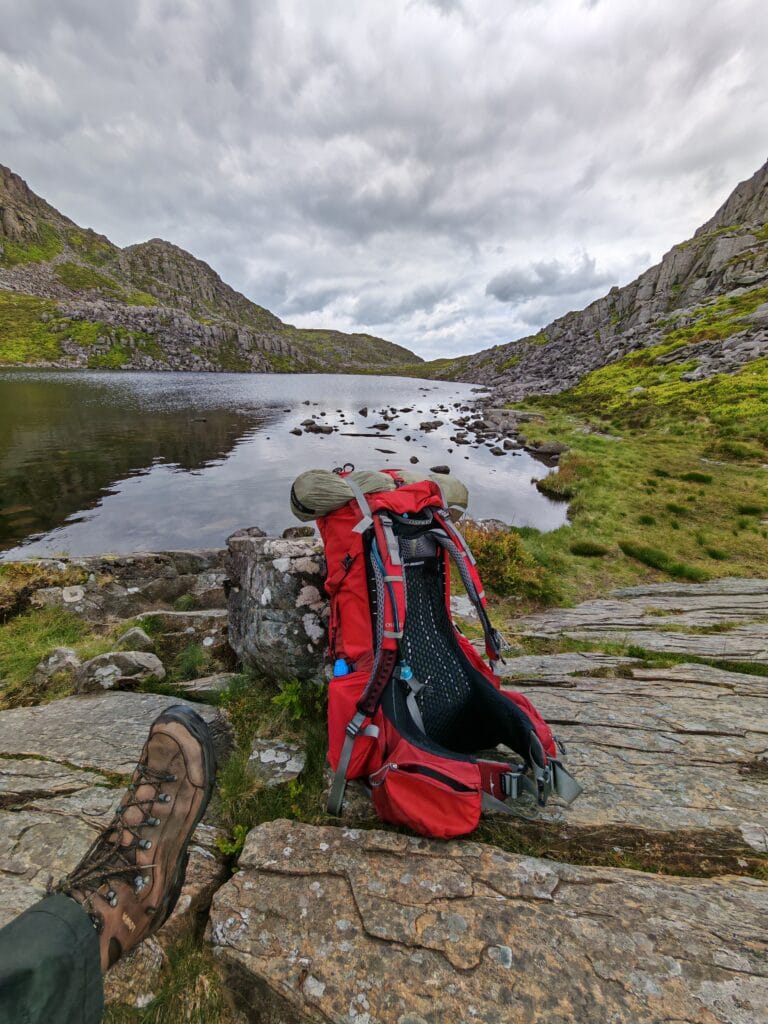
Where this pack earned its keep
I don’t review gear out of a box. Read the full destination guides and itineraries where the Osprey Atmos AG 50 hauled massive loads across global trekking routes.




Osprey Atmos 50: What I love
- Comfort & AG system – The primary reason to buy this pack is the incredible Anti-Gravity (AG) suspension and all-day comfort. The AG system spreads the weight across the body and creates great ventilation using a suspended mesh panel. This means you barely feel the pack’s load over multiple days of trekking, and it eases the burden when doing ascents. The curved design of hip straps secures your waist like a hug, and the cushioned shoulder straps create amazing on-trail comfort. It’s a very ergonomic design once you’ve adjusted the back panel and shoulder straps.
- Versatile Pockets – The Osprey Atmos AG 50 has a great variety of pockets in smart locations to help best divide up your gear. As listed above, there are so many different attachments and pockets that make organisation much easier. I like the removable lid, which offers an option as a carry-alone item or to lighten the pack for fast work.
- Adjustability – This bag seems to have too many straps until you fill it and realise it helps stability. The Fit-On-The-Fly system allows the curved hip straps to adjust easily for the optimum fit. The clever loop placement means poles and items on the exterior can be attached. As well as some carabiners and climbing kit attachments. This backpack has been engineered to focus on ergonomics and comfort with effective results.
- Durability – After many trips with this backpack, it doesn’t look like it’s done multiple treks. The materials aren’t crazy lightweight, but that means they’re more robust on the trail. And you don’t have to worry about it on planes, coaches, or other transport getting damaged. It manages to stretch when packing gear into it and doesn’t feel fragile.

Osprey Atmos 50: Worth knowing
- Weight-to-capacity ratio – For carrying larger loads, a better backpack is the Aether 55. The Atmos 50 is very capable up to 20kg from experience, but it is better to carry loads below 18kg. The AG system makes the bag feel several kilograms lighter than it is, but it does have a limit.
Tip: The general rule of thumb for pack weight is around 20-25% of your body weight. - Price – This premium backpack is priced according to the competition, and you get a lot of backpacks for the money. Osprey has a reputation for high-quality backpacks, and this best seller proves people are willing to splash the cash for the model. The end-of-season sales are the best time to grab a bargain or when new versions are being launched for a deal.
- Noise – A slightly odd nuisance to pick up on, but the trampoline-style AG system can creak and be loud if not properly adjusted. I sometimes zone it out, but other people have commented on it. However, in my opinion, it’s a small price to pay for incredible comfort and support. The newer version is as comfortable and quieter, which shows how Osprey are always refining classic designs.
Backpack Alternatives
While the Osprey Atmos AG 50 is a phenomenal piece of engineering, the mid-sized trekking backpack market is highly competitive. Depending on whether you prioritise ultralight weight, heavy-load hauling, or specific internal organisation, it is always worth cross-shopping. Here is how the Atmos stacks up against its closest rivals:
1. Osprey Exos 48 / 58
- Pros: Significantly lighter than the Atmos, excellent ventilation, highly compressible.
- Cons: Less padding on the hip belt, struggles to carry loads over 15kg (35lbs) comfortably.
- Best For: Ultralight backpackers and thru-hikers. If you are obsessed with cutting weight and have already invested in ultralight sleeping bags and tents, the Exos is the logical choice. It uses a lighter suspension system that is brilliant for fast-paced miles, but it completely lacks the plush, wrap-around comfort of the Osprey Atmos AG 50 when you are forced to carry heavy food and water.
2. Gregory Paragon 48 / Baltoro 65
- Pros: Exceptional internal organisation, highly adjustable FreeFloat suspension, and included rain cover.
- Cons: Slightly heavier, less back ventilation compared to Osprey’s Anti-Gravity mesh.
- Best For: Hikers who love meticulously organising their gear. Gregory is Osprey’s biggest direct competitor, and their Paragon (or the heavier-duty Baltoro) is a masterclass in organisation. It features a massive U-zip front access panel that makes finding gear in your tent much easier than the top-loading Atmos. However, the foam back panel simply cannot compete with the Atmos when it comes to cooling airflow on sweaty, high-altitude climbs.
3. Osprey Aether 55
- Pros: Custom Fit-on-the-Fly hip belt, built for massive loads, incredibly durable.
- Cons: Noticeably heavier empty weight, over-engineered for simple weekend trips.
- Best For: Heavy Loads and winter backcountry camping. If you regularly carry 18kg (40lbs) or more because you are hauling bulky winter gear, camera equipment, or extra supplies for a partner, the Aether is the step up. It sacrifices the floating, airy feel of the Atmos AG for a much stiffer, more rugged frame designed specifically to stabilise punishing weights.
4. Deuter Aircontact Core 50+10
- Pros: Legendary German durability, expandable volume (+10L), great load transfer.
- Cons: One of the heaviest packs in its class, somewhat bulky aesthetic.
- Best For: Rough, off-trail bushwhacking and hikers who are tough on their gear. Deuter packs are virtually indestructible. The Aircontact Core uses a robust, highly padded foam system rather than suspended mesh. It is a fantastic workhorse that can comfortably take a beating on jagged rock faces, but you will pay for that durability with a much heavier base weight than the Atmos.
Kit Rating
Final Thoughts
My decision to invest in the Osprey Atmos AG 50 has been justified on literally every trek, international trip, and local training hike I have thrown at it since. 50 litres is the absolute perfect capacity—it provides sufficient space for my clothes, tech, camping equipment, and sleep system, while actively preventing me from over-packing unnecessary luxury items.
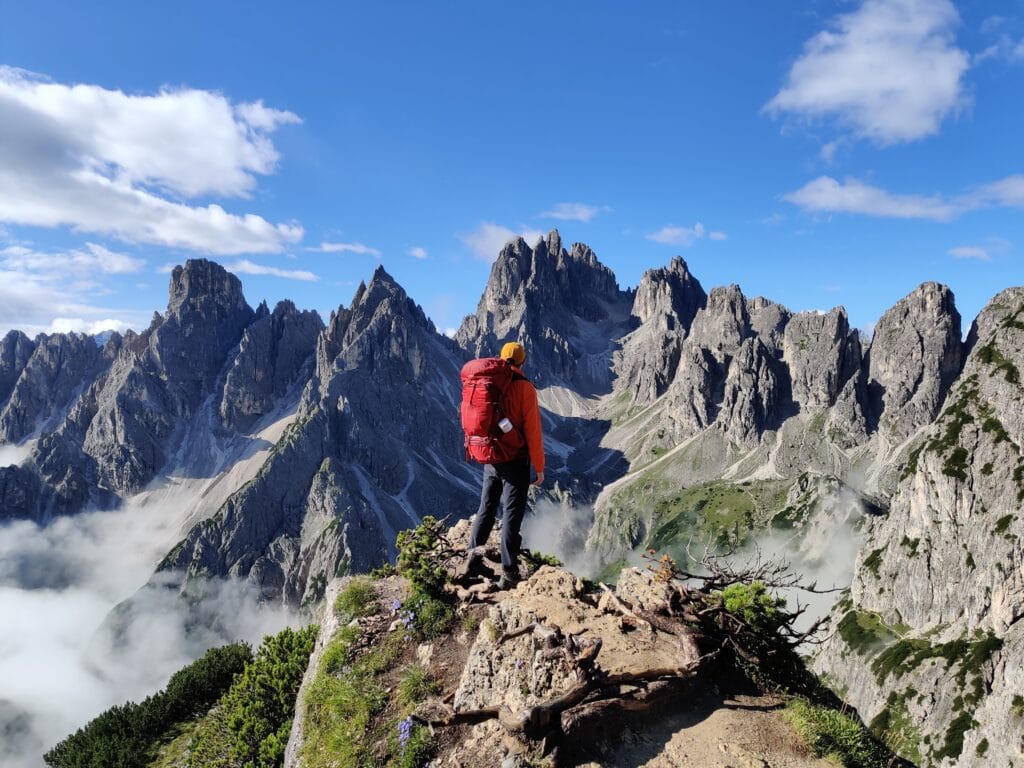
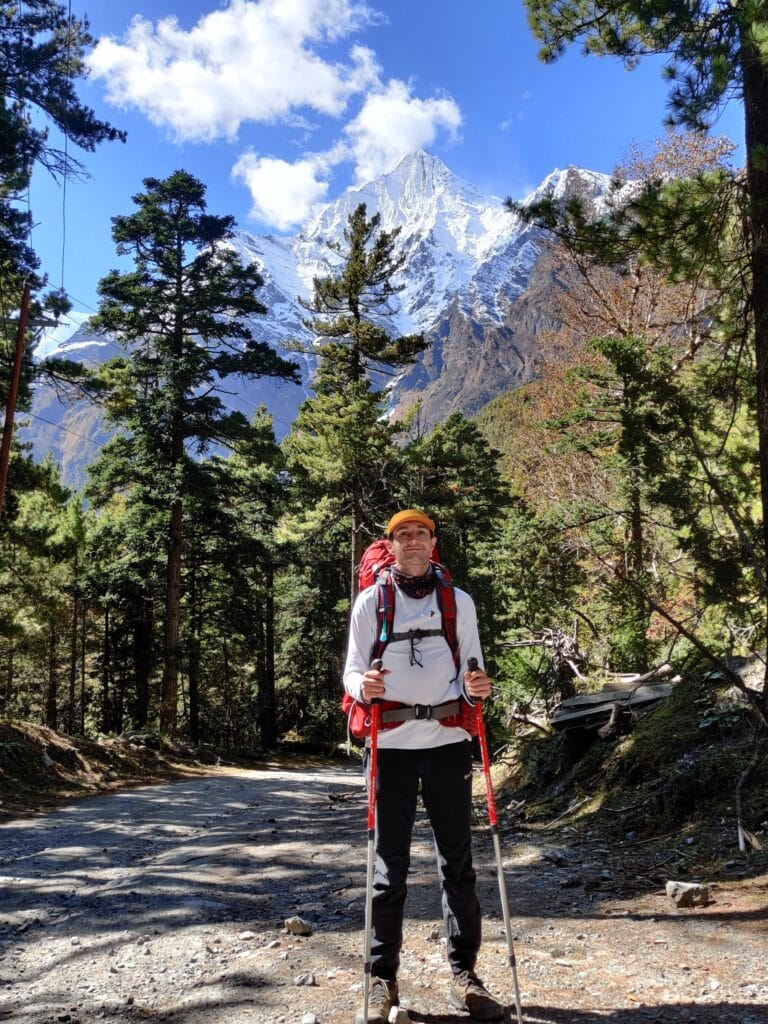
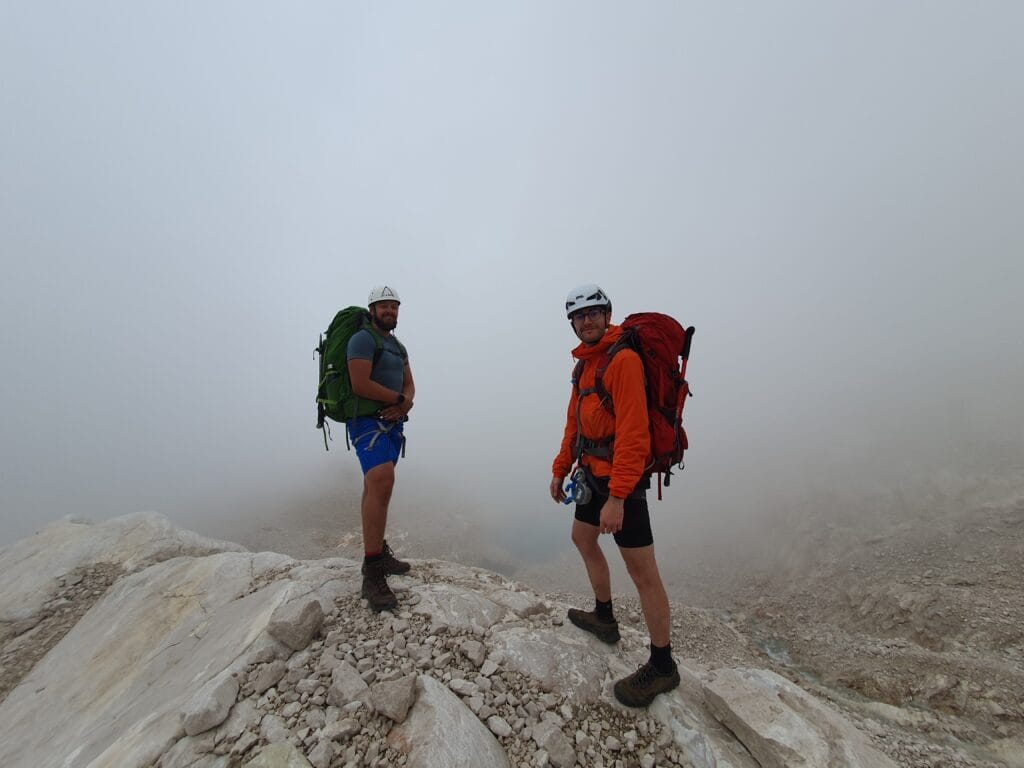
The incredible Osprey Atmos AG 50 has scaled exposed Via Ferratas in the Italian Dolomites, survived rugged road trips through the Canadian Rockies, hauled my life over the 5,416m Thorong La Pass on the Annapurna Circuit, and will be joining me on the O-Circuit in Patagonia very shortly. It truly can do it all, effortlessly transitioning from 1-night wild camping trips to full-on, multi-day backcountry expeditions. The vibrant red colour is easily spotted on a mountain in case of emergencies, and from a purely aesthetic standpoint, I love that the 50L profile doesn’t look absurdly oversized in summit photos.
You will see the Atmos series being used by hikers on almost every major trail around the world for a very good reason. If you are looking for an uncompromising balance of weight, premium comfort, and smart features, it is incredibly hard to top the Osprey Atmos AG 50.
What is the best trekking backpack in your opinion? And if you own an Osprey Atmos or Aura backpack, what are your thoughts on it? Please share this post with other backpackers, hikers and trekkers looking to buy a new backpack.
FAQs
Is a 50L backpack big enough for a multi-day trek?
Yes, a 50L backpack like the Atmos AG 50 is the perfect sweet spot for a 3-to-5-day trek, but it can work up to 2 weeks if not camping or carrying much food. It forces you to pack efficiently, keeping your overall weight down, which drastically improves comfort on the trail. If you are carrying bulky winter sleeping bags or a large 3-person tent, you may need to upgrade to the 65L version or get ultralight, high-performance and premium gear.
What is the Osprey Anti-Gravity (AG) system?
The Anti-Gravity (AG) system is Osprey’s proprietary suspension design. It features a continuous panel of lightweight mesh that extends from the top of the back panel all the way down into the hip belt. This design seamlessly wraps your body, transferring the pack’s weight evenly off your shoulders while providing massive airflow to prevent a sweaty back.
Does the Osprey Atmos AG 50 come with a rain cover?
Recent models of the Osprey Atmos AG 50 do include an integrated, removable rain cover stowed in the lid or base of the pack. However, it is always recommended to use internal dry bags for critical items like your sleeping bag and electronics.

Does it fit in an airplane overhead as a carry on? My Atmos 58 won’t.
Hi Carey, unfortunately the Atmos 50 does not fit in the overhead lockers (typically: 56 cm × 45 cm × 25 cm). Most trekking backpacks are over 65cm tall so it would need to go in the hold or find a backpack with a smaller volume below 40L. Osprey’s UNLTD™ Hike AntiGravity 32L, Stratos 34 and HikeLite 32L are close to dimensions if full.
For Women, the Tempest 34 and Tempest pro 30 are OK for overhead lockers. Hope that helps!
Pingback: Annapurna Circuit Trek: Everything you need for an Epic Adventure - Backpacker's Mentality
Pingback: Annapurna Circuit Trek: The Trip that changed my Life - Backpacker's Mentality
Pingback: The Osprey Hikelite 18 Backpacks: A Hiker's Perspective - Backpacker's Mentality
Pingback: The Osprey Hikelite 26 Backpack: A Hiker's Best Friend - Backpacker's Mentality
Pingback: Annapurna Adventure: Preparing for the trek of a lifetime - Backpacker's Mentality
Pingback: Osprey Fairview 40: The Most Versatile Women's Travel Backpack - Backpacker's Mentality
Pingback: Sea to Summit Ultralight Insulated Sleeping Pad: Reasons to Love it - Backpacker's Mentality
Pingback: Rab Cirrus Hut Slipper: The Best Camp Shoe - Backpacker's Mentality
Pingback: Osprey Aura AG 50: The Best Women's Trekking Backpack - Backpacker's Mentality
Pingback: Scarpa Mescalito Planet: The Best Approach Shoe - Backpacker's Mentality
Pingback: Ultimate Guide to the Torres del Paine O Circuit - Backpacker's Mentality