BACKPACKER’S MENTALITY · GEAR REVIEW
| QUICK VERDICT– Overall Rating: 8.7 / 10 The Salomon Genesis is a do-it-all technical trail shoe built for confident, experienced runners who want stability and durability over plush comfort or featherweight racing numbers. Its Kevlar-reinforced Matryx upper shrugs off scree and roots that would shred a lighter shoe, and the activeCHASSIS delivers confidence-inspiring control on uneven, technical terrain. The trade-offs are a snug, narrow-leaning fit and a shoe that asks a bit more of newer trail runners than a plusher, more forgiving option would. |
| Weight: ~226g / 7.96 oz (women’s size 6.5) • Stack Height: 34mm heel / 26mm toe • Drop: 8mm • Upper: Matryx® with Kevlar® • RRP: USD $170 |
Field Note: This guide contains affiliate links. If you purchase gear through these links, I may earn a small commission at no extra cost to you. I only recommend equipment I have personally mountain-tested and trust.

Salomon Genesis: Introduction
Most trail running shoes force you to choose between comfort and control. High-stack shoes cushion every step but can feel disconnected on technical terrain, while lower-profile options often sacrifice long-distance comfort in pursuit of precision.
The Salomon Genesis attempts to sit directly in the middle. Built as a mountain-focused trail runner, it combines substantial cushioning with a surprisingly stable platform, aiming to provide enough protection for all-day efforts without compromising confidence on rocky descents and technical singletrack.
After putting the Genesis through steep North Shore trails, alpine hikes, and long days on mixed terrain, I’ve been impressed by just how versatile this shoe is for Roisin. It doesn’t have the razor-sharp precision of a Norda 002, nor the maximal cushioning of a HOKA Speedgoat, for example, but it might offer one of the best balances of comfort, grip, and mountain capability currently available.
This review draws on Roisin’s ongoing trail use across variable Coast Mountains terrain — rooty descents, scree traverses, and long days out — combined with a wide base of independent long-term testing, since a shoe like this only really reveals its character after real miles.
FIELD NOTES
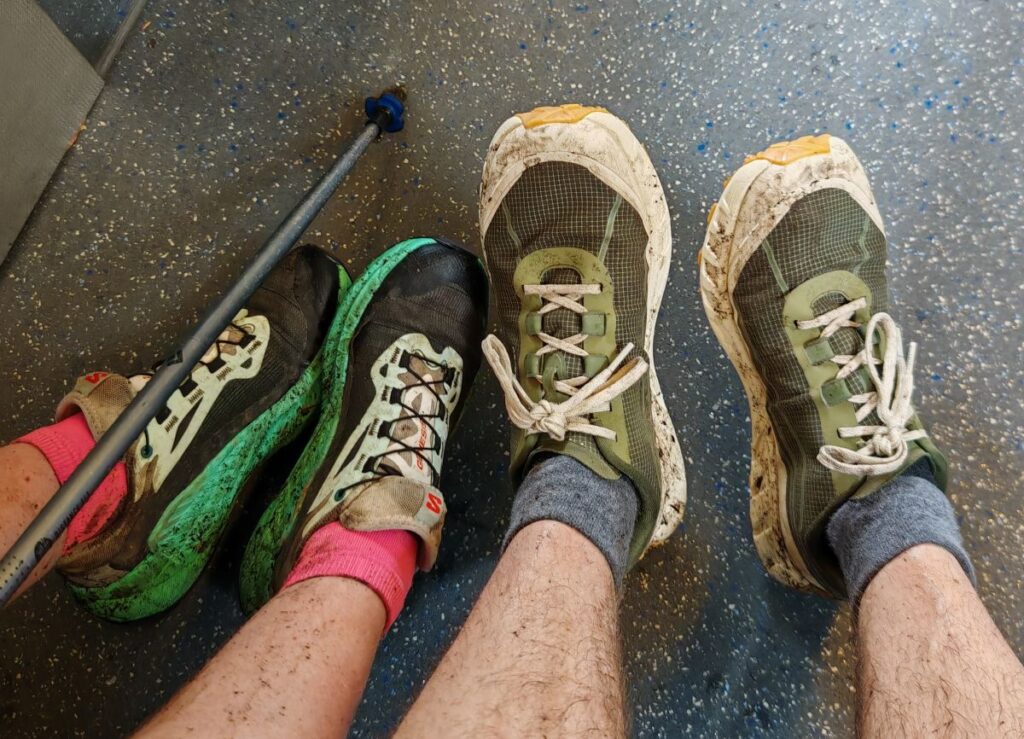
Roisin has been running the Salomon Genesis on the same rooty, rocky Coast Mountains singletrack I’ve been putting the Norda 002 through, and it’s given us a useful side-by-side view of two very different design philosophies solving the same problem: how to move confidently and quickly across technical terrain without your shoe becoming the limiting factor.
Where the Norda leans into minimal stack and maximum ground feel, the Salomon Genesis takes a more protective, structured approach — a moderate 34/26mm stack, an 8mm drop, and a Kevlar-reinforced upper built to survive damage from scree fields and root systems. Salomon built it for runners who want to move fast and technical without protecting their footwear, and after a season on BC trails, this verdict holds up.
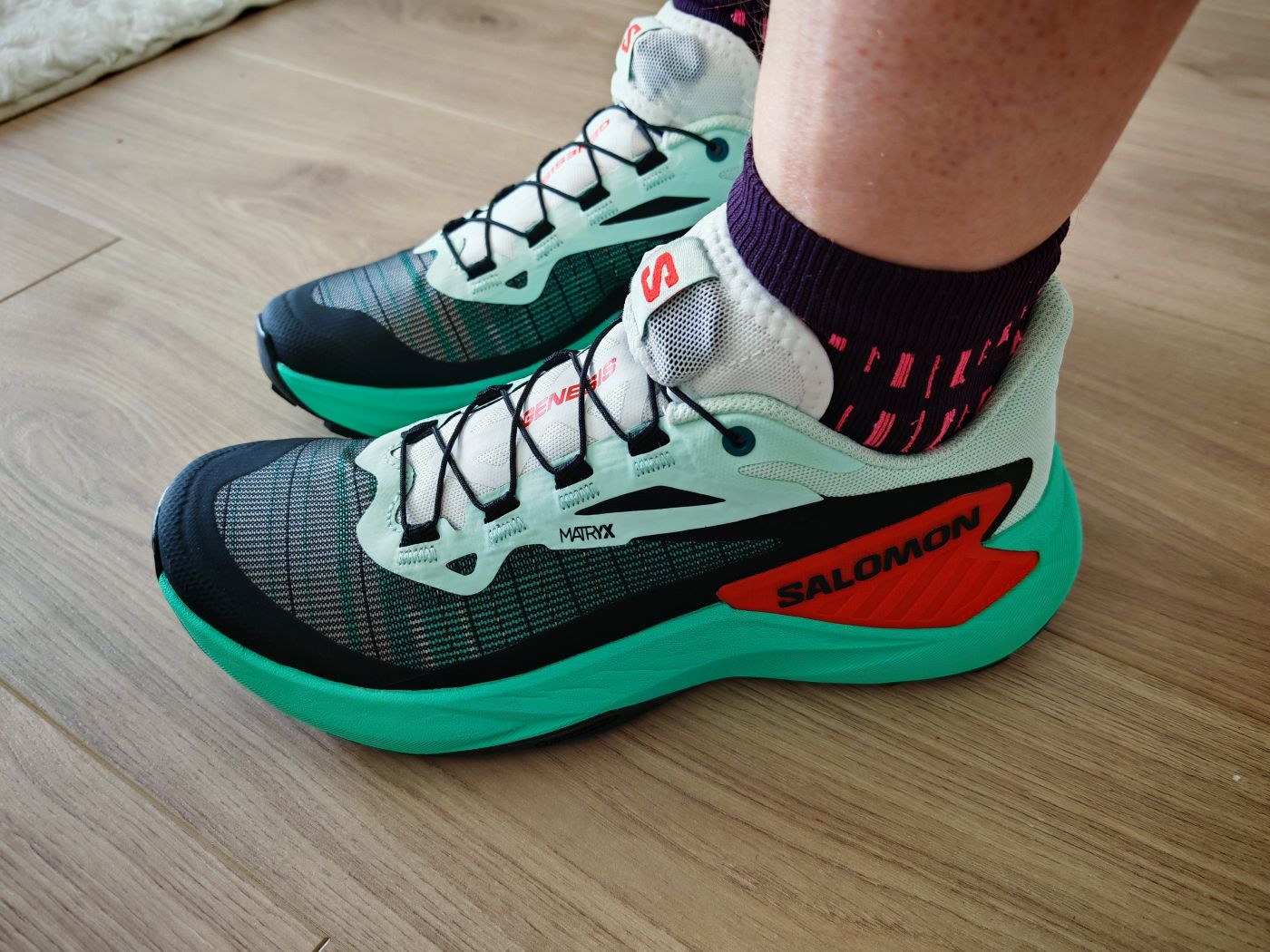
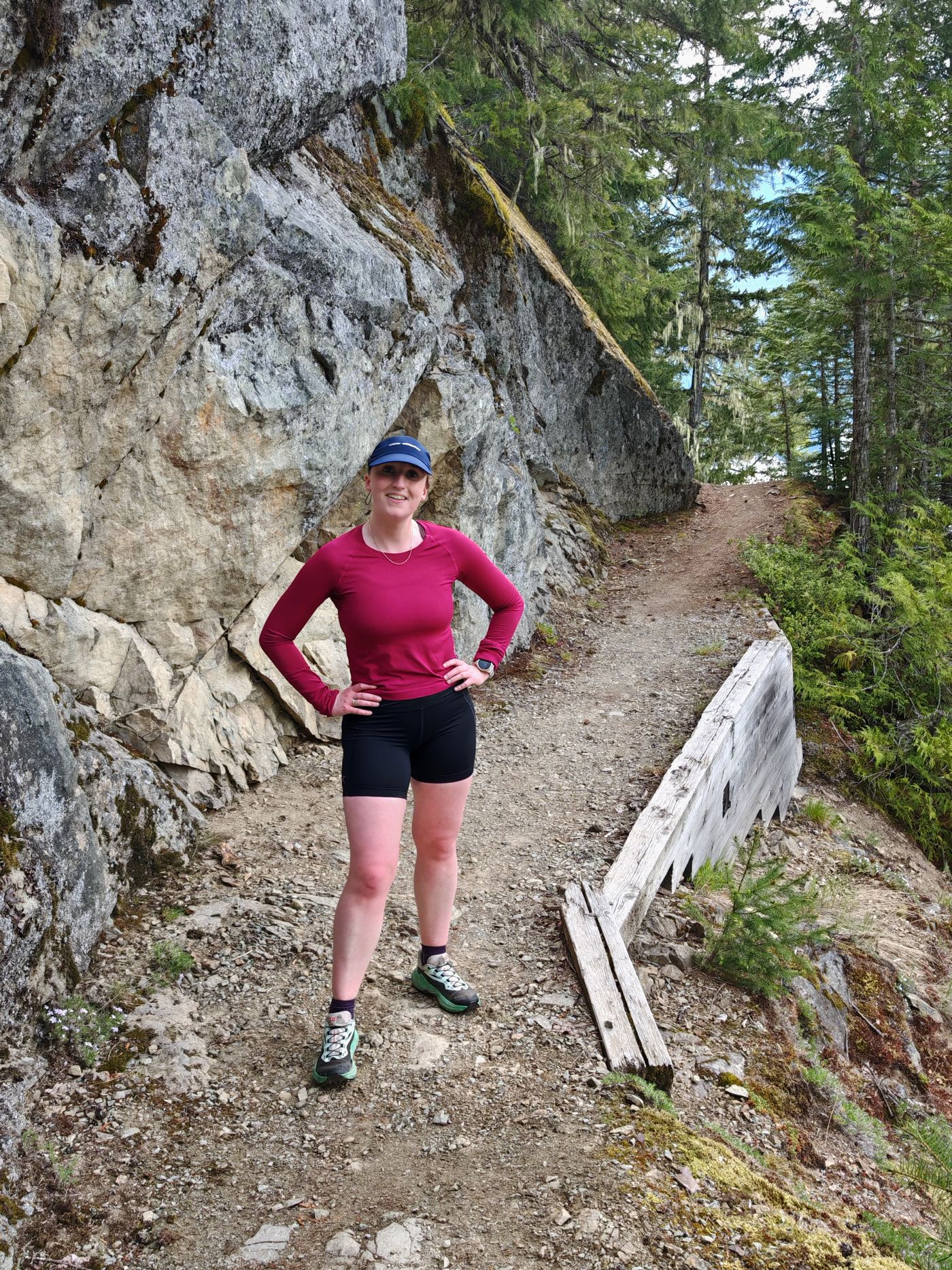
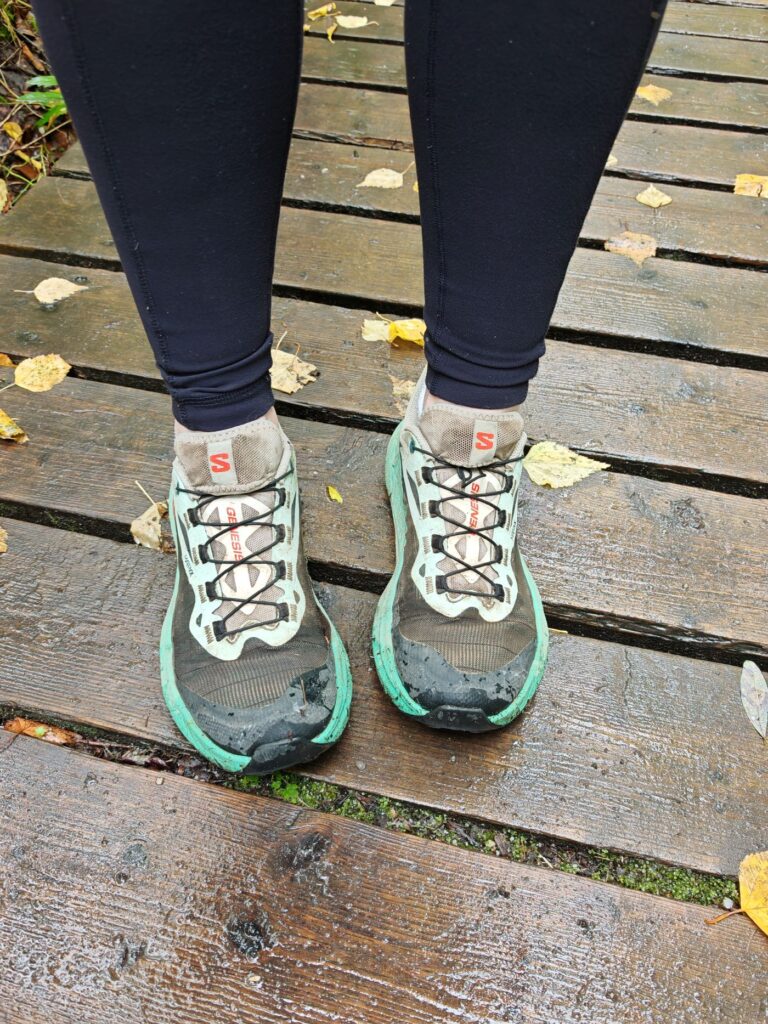
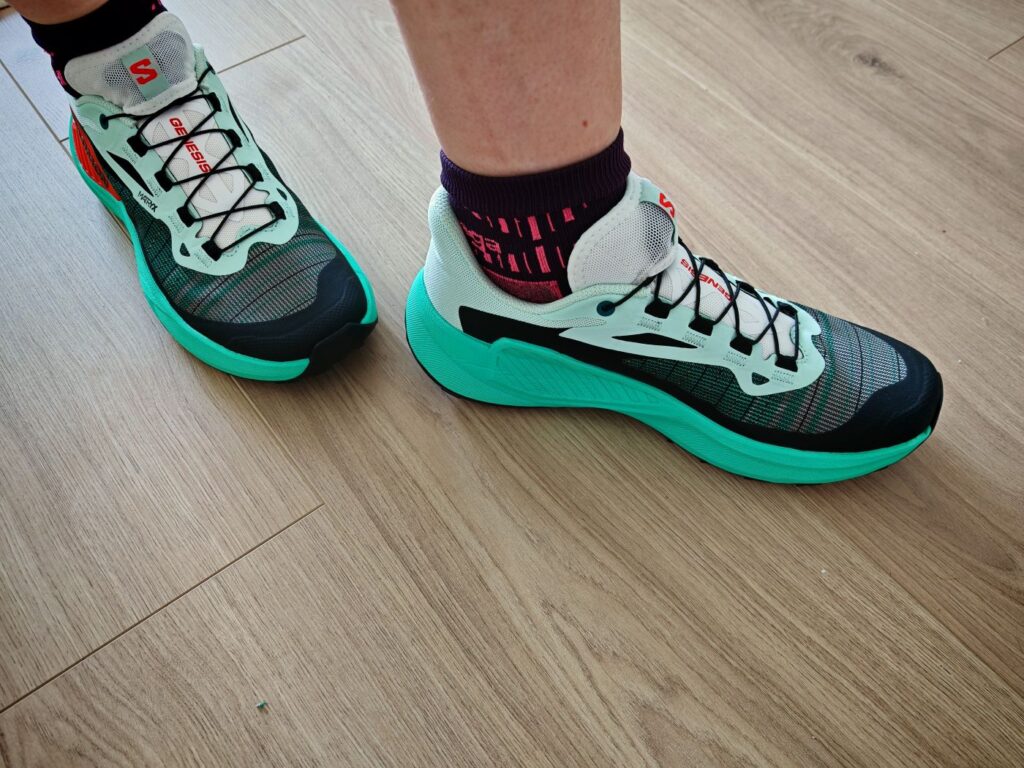
Roisin loved the colour scheme with the aqua blue/green and red details, which don’t quite look as clean now but add to the overall style. Salomon offers a range of colour schemes from classic black and muted colours with some brighter, more expressive colours too. The Salomon Genesis is available in both men’s and women’s versions, with the women’s model featuring a slightly different fit geometry to better accommodate a narrower heel and lower-volume foot. Both versions use the same core technologies, including the Matryx® upper, energyFOAM midsole, activeCHASSIS support system, and Contagrip® outsole, so performance remains largely identical across the range.
Alongside the standard breathable model, the shoe is also available as the Genesis GTX, which incorporates a GORE-TEX membrane for additional weather protection. While the GTX version is better suited to wet climates and shoulder-season hiking, the standard Genesis remains the better choice for most trail runners thanks to its improved breathability, quicker drying time, and lighter feel on long days in the mountains.
Salomon Genesis
Salomon S/LAB Genesis vs Salomon Genesis
The popular and competitive S/LAB Genesis is the race-focused sibling of the standard Genesis, developed with input from Salomon athletes competing in ultra-distance mountain events such as Ultra Legend Courtney Dauwalter. It trims weight, uses lighter and more performance-oriented materials, and delivers a more precise, locked-in fit aimed at faster runners tackling technical terrain at speed.
The standard Salomon Genesis feels noticeably more approachable for most trail runners. It provides a little more comfort, a more accommodating fit, and better value for most runners who split their time between trail running, fast hiking, and mountain adventures. Unless you’re racing regularly or chasing every gram, I’d recommend the regular Genesis as the better all-round shoe.
Salomon Genesis vs Salomon Genesis 2
The Genesis 2 is an evolution rather than a complete redesign. Salomon has refined the upper for improved comfort and durability, slightly improved the fit through the midfoot, and made subtle tweaks to increase long-distance comfort without fundamentally changing the ride.
The original Genesis remains an excellent mountain shoe and still offers most of the performance that made the model successful in the first place. This review covers the original Genesis specifically, which remains widely available and, at the time of writing, is often discounted as retailers transition stock. If you’re buying new and prices are similar, I’d choose the Genesis 2. If you can find the original Genesis on sale, then I would pull the trigger, as you’re giving up very little in real-world performance.
Design & Build Quality
The standout engineering feature is the Matryx® upper — a woven textile that integrates individually-coated, high-tenacity Kevlar® fibres alongside technical yarn. This isn’t a marketing ploy, as Kevlar is known for its cut and abrasion resistance in far more demanding applications than running shoes, you know, such as bulletproof vests. That’s one strong material to include in a durable trail runner, and it shows in how the Genesis holds up against scree, roots, and rock contact that would shred a standard mesh upper within a season.
Underfoot, Salomon’s activeCHASSIS — a thermoplastic support frame — provides lateral guidance and stability without the stiffness penalty you might expect from a structured support system. It’s a considered piece of design that allows the shoe to stay agile and flexible through the gait cycle while still resisting the ankle roll and lateral instability that technical, uneven terrain tends to expose in less structured shoes. The Quicklace™ one-pull lacing system delivers even pressure across the midfoot, though Roisin’s own experience noted the pull cord doesn’t retract quite as smoothly as other competing quick-lace systems and can run slightly long; thankfully, there’s a simple way to tuck away the laces by the front tongue.
On-Trail Performance — Trail Running
On the same rooty, technical Coast Mountains terrain we’ve been testing other trail shoes on, the Genesis’s defining characteristic is confidence on uneven ground. The activeCHASSIS delivers on side-hilling on loose scree and navigating root-tangled descents, where both felt notably more controlled and stable than in a less structured shoe, without the ride ever feeling harsh or over-engineered. This is a shoe built to be actively driven rather than passively ridden along trails. This helps keep momentum when running down BCMC on Grouse, hopping over rocks and roots easily. The Salomon has helped unlock Roisin’s confidence and made her more comfortable making quick, confident foot placement decisions rather than a shoe that does that thinking for you.
The 8mm drop is worth flagging as a deliberate design choice rather than a compromise. It’s on the higher end for the trail running category, which Roisin has found helpful for reducing Achilles and calf strain on long, technical days — a detail worth knowing if you’re coming from a lower-drop shoe and adjusting your stride accordingly.

On-Trail Performance — Hiking & Backpacking
The Salomon Genesis is marketed as a trail running shoe, but it’s equally at home on fast hikes and lightweight backpacking trips. The combination of a cushioned energyFOAM midsole, supportive activeCHASSIS, and durable Matryx® upper provides a reassuring blend of comfort and stability when carrying a light pack over long distances. We tested this in Yosemite on a one-night wilderness camping trip to Dewey Point, where the Salomons helped ventilate in the hot weather and support a heavy Osprey Aura AG 50 load.
On technical trails, rocky scrambles, and uneven terrain, the Genesis feels more secure than many hiking-focused shoes, making it an excellent option for hikers who value agility and trail feel over the bulk of traditional boots. For backpacking trips with moderate loads, it strikes an impressive balance between running-shoe comfort and mountain-ready protection. The Salomon runners will get plenty of more mileage as we ramp up ultramarathon training in 2027.

Traction & Durability
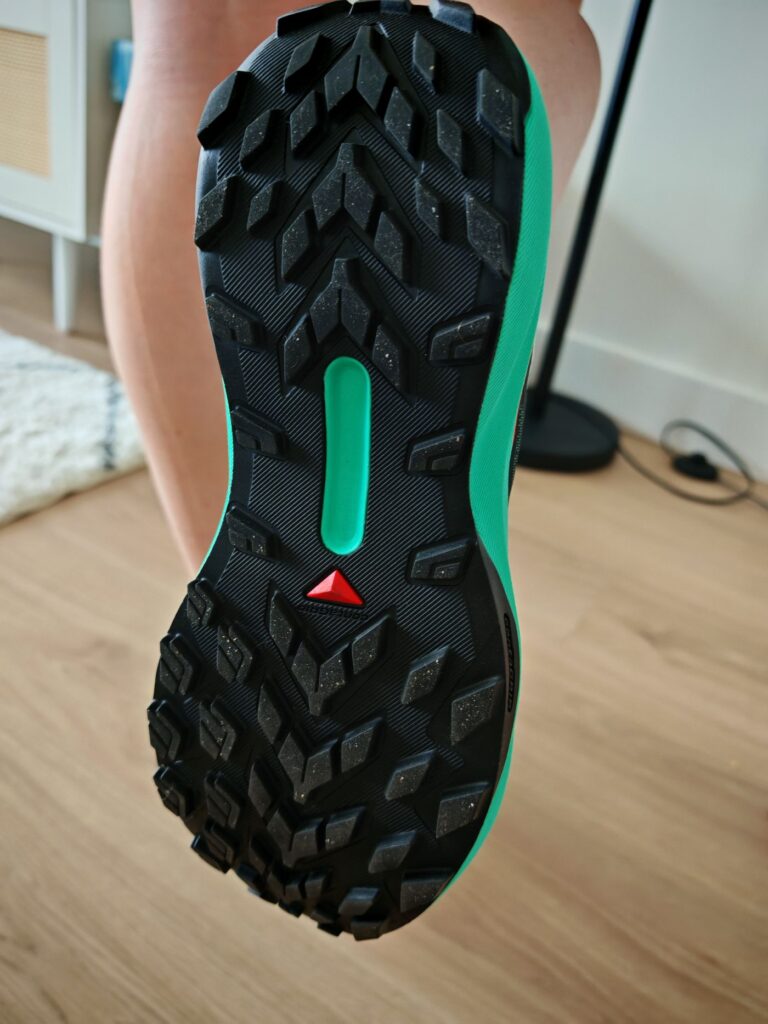
The Contagrip® outsole, with 4–5mm lug depth, delivers better-than-average grip across a wide range of surfaces from dry trail, loose gravel, wet roots and without quite matching the top-tier stickiness of Vibram Megagrip on the Norda 002 or La Sportiva’s FriXion White compounds found on the acclaimed Prodigio Pros. On smooth, wet slab specifically, occasional slippage is to be expected, and that tracks with our own observations on damp granite sections in Yosemite. Overall, the Salomon Genesis is trustworthy for the vast majority of trail conditions, just not quite approach-shoe-level sticky on the most technical rock.
Durability is where the Salomon Genesis separates itself from lighter, more minimalist rivals. After a full year of varied trail use, the Matryx/Kevlar upper shows minimal wear with no fraying, no delamination, none of the scuffing you’d expect on a standard mesh upper after the same mileage on abrasive Coast Mountains stone and scree. This is a shoe built for day-in, day-out abuse rather than a shoe that you need to be cautious with.
Fit & Comfort
This is the area where buyer awareness matters most. The Salomon Genesis runs standard to slightly narrow, particularly through the midfoot and toe box. So it’s most comfortable for average to narrower feet, which was a key selling point for Roisin. Whereas for myself or anyone with a wider foot, it’s worth trying a half size up or looking for a wider toe box. Roisin’s experience across a full season has been that the fit stays secure and precise rather than plush, which fits the shoe’s overall character. Overall, the Salomon Genesis is a technical, performance-focused shoe rather than a comfort-first daily trainer.
The soft, articulated heel counter with padded tongue and collar does improve comfort and lockdown, and heel slip has not been an issue across varied technical terrain, which matters enormously on steep, loose descents where a sloppy heel fit undermines confidence fast.
Salomon Genesis Pros & Cons
✔ PROS
- Exceptional durability — Kevlar-reinforced Matryx upper shrugs off scree and roots better than nearly any shoe in this category
- activeCHASSIS delivers confidence-inspiring stability and lateral control on technical, uneven terrain
- Secure heel lockdown with minimal slip on steep, loose descents
- 8mm drop is a benefit for runners prone to Achilles or calf strain on long days
- Above-average Contagrip traction across a wide range of trail surfaces
- Competitively priced at USD $170 / $190 CAD given the durability and stability on offer from a reputable brand
✘ CONS
- Snug, slightly narrow fit through the midfoot and toe box — not ideal for wider feet
- Quicklace pull cord doesn’t retract as smoothly as some competing systems and can run long even when tucked
- Traction falls short of Vibram Megagrip or FriXion White rivals on smooth, wet rock specifically
- At ~226g, it’s on the heavier side of average for the category — not the shoe for weight-conscious racing
- Demanding, precise ride may be less forgiving for newer trail runners compared to plusher options
- Since superseded by the Genesis 2, limited availability; however is now discontinued while stock lasts
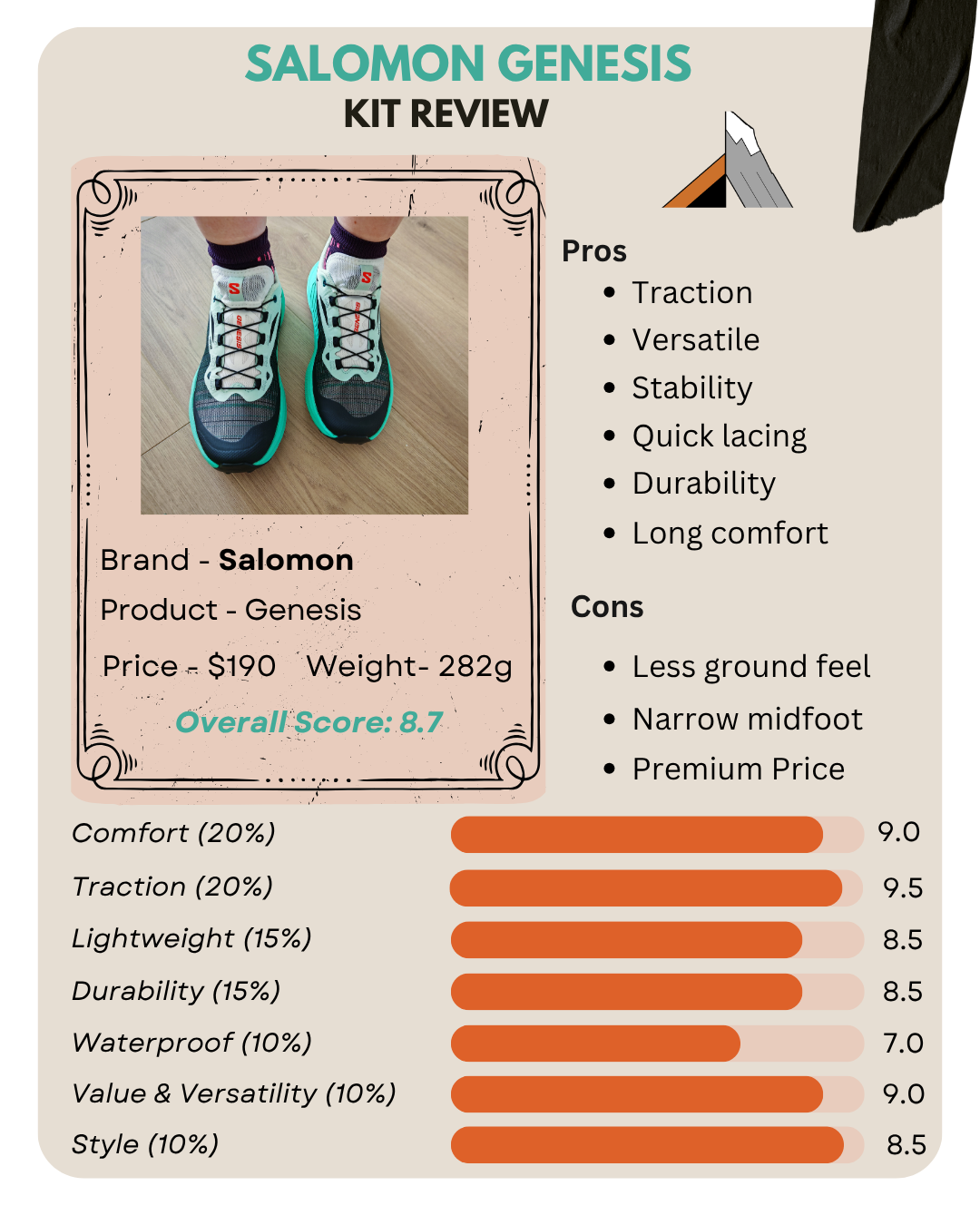
Where the Salomon Genesis earned its rating
I don’t review trail shoes from a treadmill. The Salomon Genesis was tested across technical North Shore trails, the Canadian Rockies, Yosemite granite, and remote Yukon terrain before earning its place in my mountain running rotation.




Salomon Genesis Kit Rating
Competitor Comparison
The technical all-rounder trail shoe category has a few benchmarks. Here’s where the Genesis sits against them.
Salomon Genesis vs. Hoka Speedgoat 6/7
The Speedgoat is the maximalist cushioning benchmark in this category — a higher stack (40/35mm on the Speedgoat 7) with a lower 5mm drop, built for runners who prioritise cushioned protection on long days and big vertical. It uses Vibram Megagrip, delivering noticeably better wet-rock traction than the Genesis’s Contagrip outsole. Where the Genesis pulls ahead is stability and durability — the activeCHASSIS gives a more locked-in, controlled feel on technical terrain than the Speedgoat’s softer, more forgiving ride, and the Kevlar-reinforced upper will outlast the Speedgoat’s upper under heavy abrasive use.
Salomon Genesis vs. Nnormal Kjerag 02
The Kjerag 02 is the precision-and-weight benchmark — a lighter, lower-stack shoe with a stronger ground-feel philosophy, built by the team behind Kilian Jornet’s technical trail shoe lineage. It uses Vibram Megagrip with Litebase, offering superior traction to the Genesis on technical wet rock. The Genesis, meanwhile, offers a more cushioned, comfortable ride for long days and a fit that many runners find more accommodating than the Kjerag’s narrower last. Choose the Kjerag for maximum precision and weight savings; choose the Genesis for a better balance of comfort, stability, and all-day durability.
Salomon Genesis vs La Sportiva Prodigio Pro
The La Sportiva Prodigio Pro sits at the opposite end of the trail running spectrum from the Genesis. Built around a highly cushioned, energetic midsole, it feels noticeably softer and more propulsive on long-distance efforts, making it a compelling option for ultra-distance runners and those prioritising comfort over technical precision. The Genesis counters with a more stable platform, superior lateral support, and a confidence-inspiring feel on steep, rocky terrain where precise foot placement matters more than outright speed.
For technical mountain running, scrambling approaches, and all-day adventures on varied terrain, I’d take the Salomon Genesis. For ultra races, long trail miles, and runners wanting maximum cushioning without stepping into HOKA territory, the Prodigio Pro is arguably the stronger choice.
Which Trail Running Shoe Is Right For You?
After testing all three shoes across mountain trails, technical terrain, fast hikes and backpacking routes, each occupies a very different niche. Here’s how they compare.
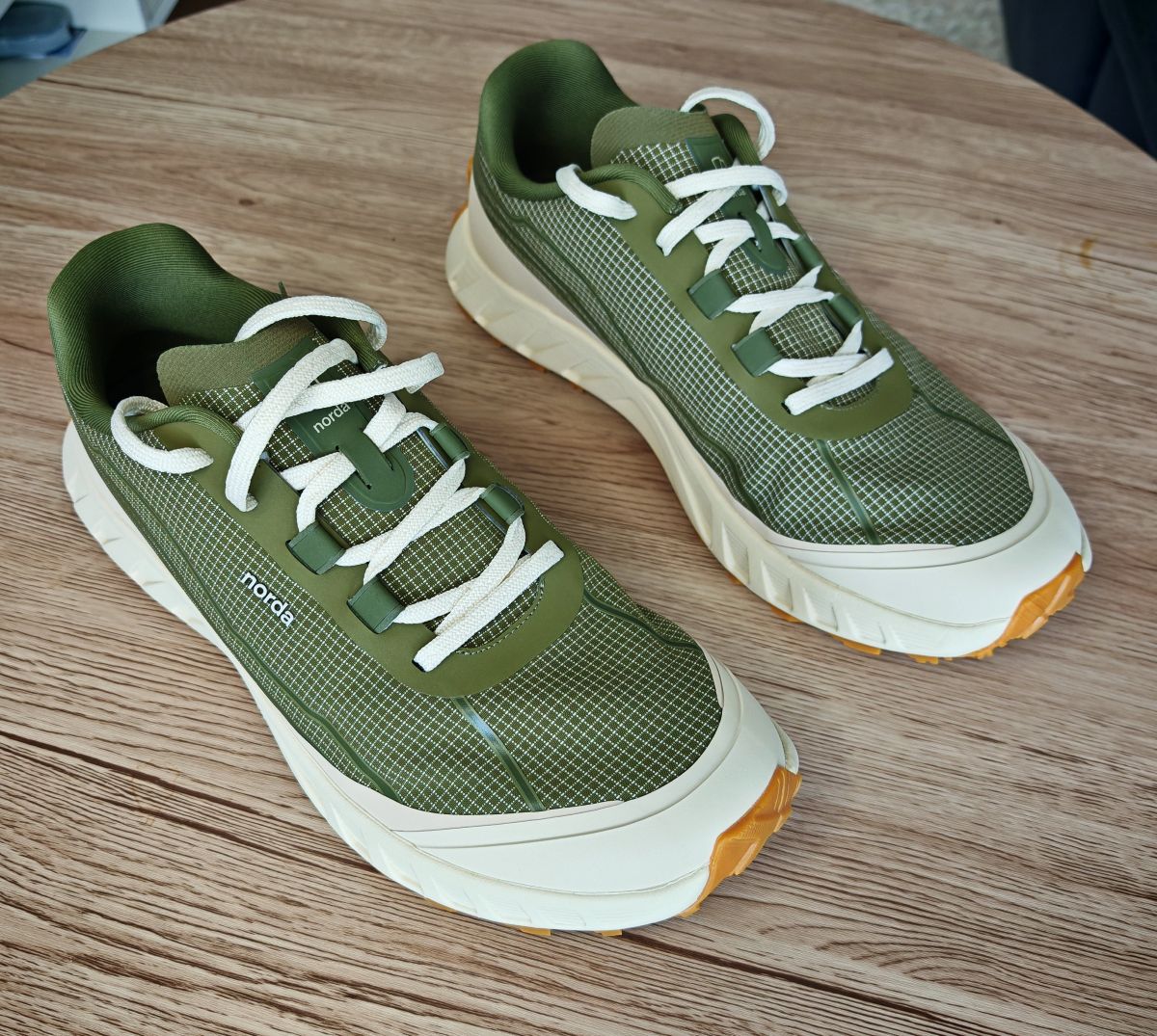
- ✓ Best trail feel
- ✓ Exceptional durability
- ✓ Outstanding grip
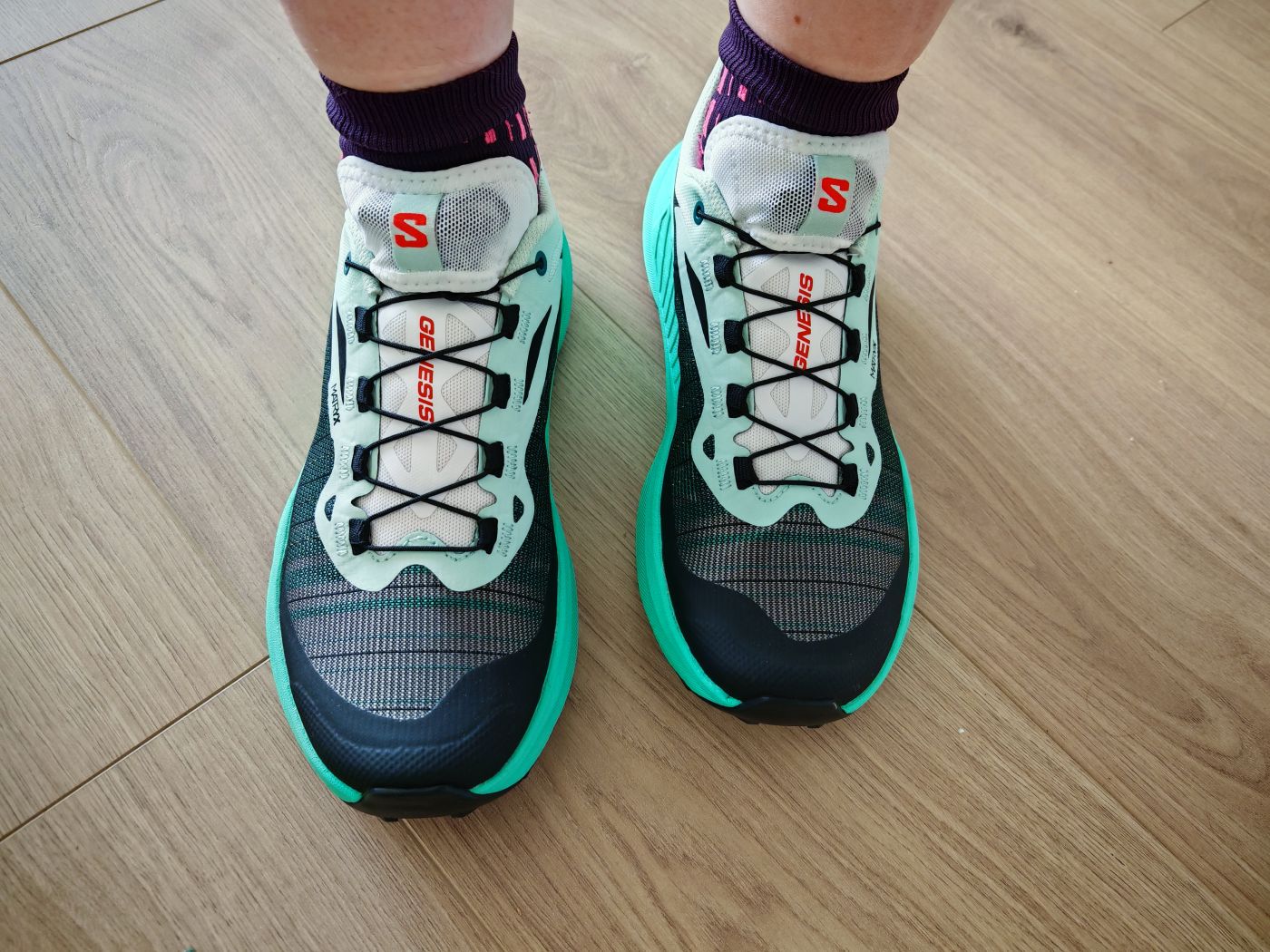
- ✓ Excellent grip
- ✓ Great comfort-to-control balance
- ✓ Highly versatile
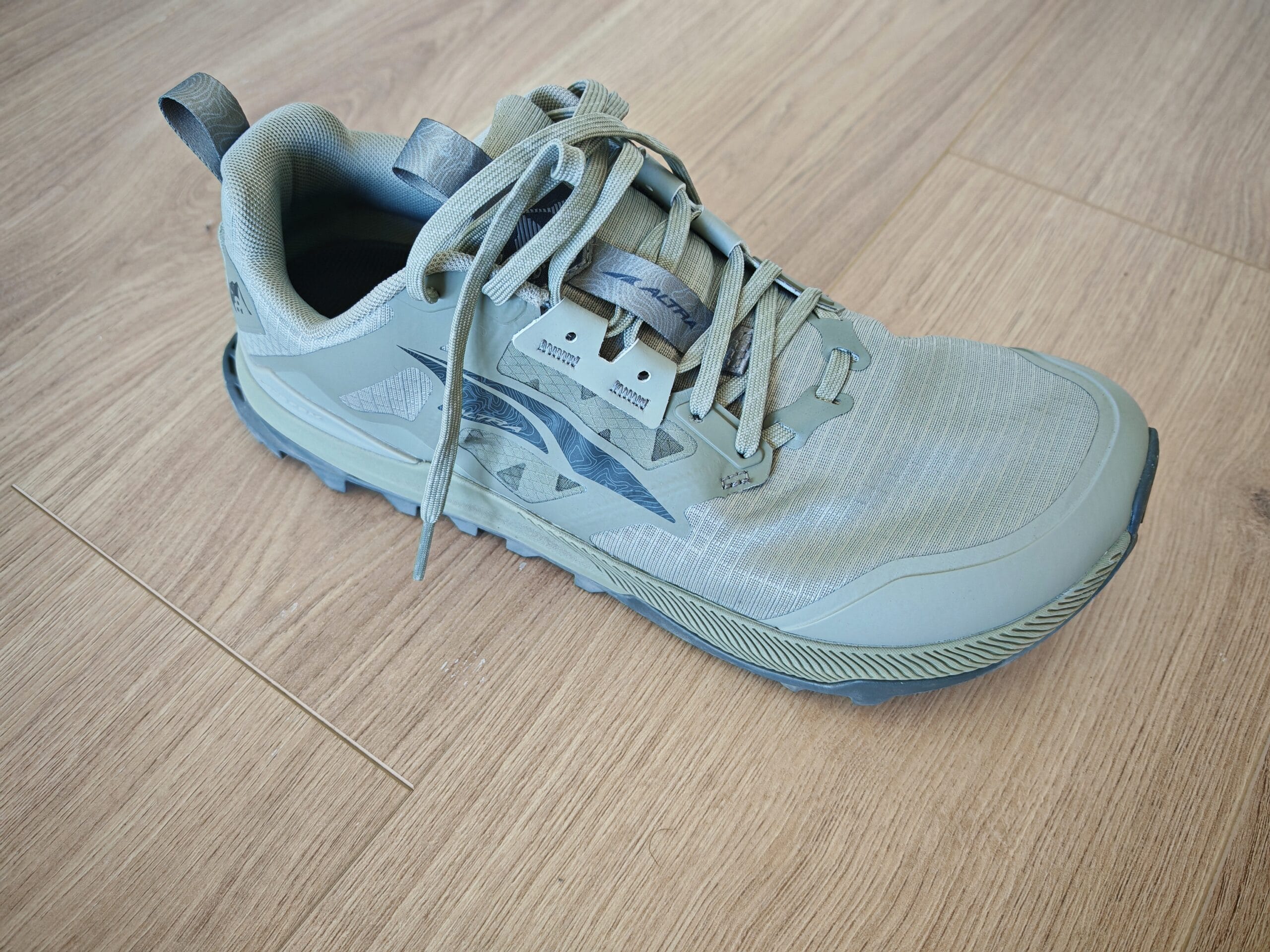
- ✓ Massive toe box
- ✓ Natural foot movement
- ✓ Outstanding hiking comfort
Who Is the Salomon Genesis For?
Ideal for: Experienced trail runners who regularly tackle technical, uneven, or rocky terrain and want a stable, durable shoe that can handle abuse without babying. If you’re the kind of runner who’s hard on shoes — scree fields, root systems, abrasive granite — the Matryx/Kevlar upper is an asset.
Also well-suited to: Hikers looking for a lightweight, agile trail shoe with enough structure and durability to handle mixed-terrain day hikes, not just running.
Less suitable for: Newer trail runners who’d benefit from a more forgiving, plusher shoe like the Hoka Speedgoat or Altra Experience Wild — the Genesis’s precise, demanding ride rewards confidence and experience rather than building it. Also less ideal for runners with wider feet, given the snug midfoot and toe box fit, or for anyone prioritising outright weight savings over durability and stability. And not for competitive racing or ultralight minimalists.
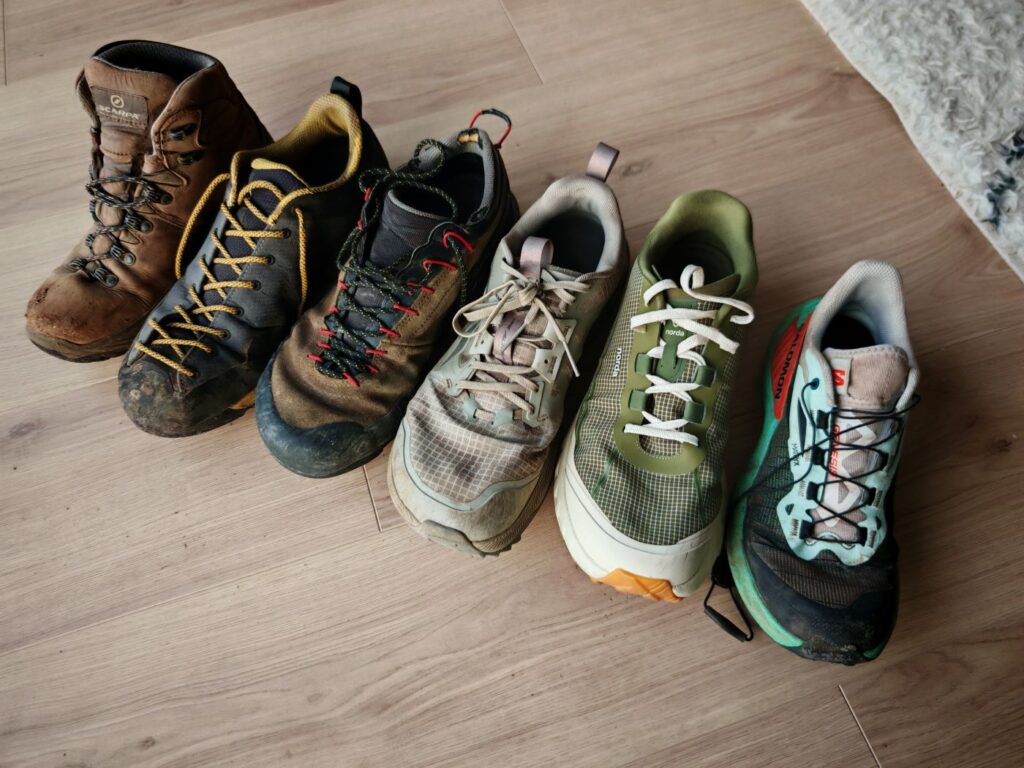
Salomon Genesis Summary
The Salomon Genesis comes remarkably close to the ideal mountain trail running shoe, combining stability, durability, comfort, and protection in a package that feels equally at home on technical singletrack, alpine terrain, and long days in the mountains. It’s not the lightest, plushest, or most precise shoe in its class, but few trail runners balance grip, control, versatility, and all-day comfort as effectively.
After extensive testing on BC’s rooty North Shore trails and technical mountain terrain, it has become the dependable option for runs where confidence and stability matter more than chasing personal bests. For runners and fast hikers seeking a durable, capable, and well-rounded trail shoe, the Genesis is one of the strongest all-round options currently available.
Frequently Asked Questions
Is the Salomon Genesis good for trail running?
Yes. The Salomon Genesis is designed specifically for trail running and performs particularly well on technical mountain terrain thanks to its combination of cushioning, grip, and stability.
Is the Salomon Genesis good for hiking?
Absolutely. The Genesis works surprisingly well as a fast hiking shoe, offering excellent comfort, reliable grip, and enough protection for long days carrying a backpack or day pack from our testing.
How does the Salomon Genesis fit?
The Genesis has a secure midfoot and heel. It runs standard to slightly narrow, particularly through the midfoot and toe box. Runners with wider feet may want to size up half a size or consider a wider-fitting alternative like the Altra Experience Wild or Hoka Speedgoat.
Salomon Genesis vs Norda 002: Which is better?
The Norda 002 offers more precision and trail feel, while the Salomon Genesis provides greater cushioning and comfort over longer distances. The Genesis is generally the more forgiving all-round shoe.
Is there a newer version of the Salomon Genesis?
Yes. Salomon has released the Genesis 2, which reportedly refines the ride while retaining the same stable, controlled character as the original. The original Genesis remains widely available and is often discounted as retailers transition stock.
What is the Matryx upper made of?
Matryx® is Salomon’s proprietary woven textile that integrates individually-coated, high-tenacity Kevlar® fibres with technical yarn, delivering exceptional abrasion resistance and durability while remaining lightweight and breathable.