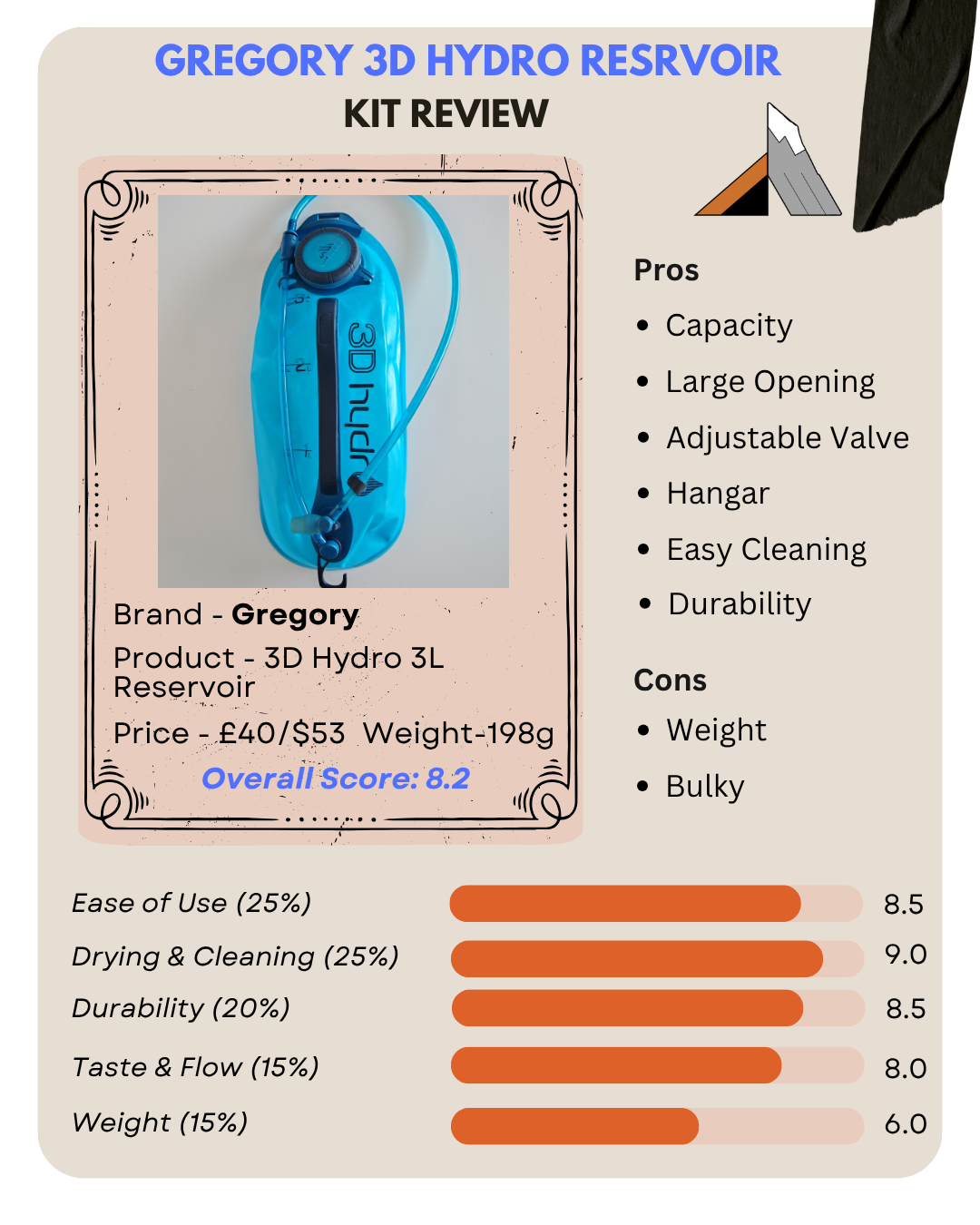
| Quick Verdict – The Gregory 3D Hydro 3L Reservoir is the hydration Bladder for the person who requires additional capacity and useful features for wild mountain adventures. The self-supporting 3D shape solves the drying-and-mould problem better than almost anything else on the market—it just asks you to carry roughly 60% more weight than a basic flat-slab bladder to get there. Overall Rating: ★ 7.6 / 10. |
| Weight: 198g / 7 oz • Capacity: 3L (also in 1.5L / 2L) • Compatibility: SpeedClip-enabled Gregory packs + universal hydration sleeves • RRP: USD $50 / CAD ~$65 / £40 |
Field Note: This guide contains affiliate links. If you purchase gear through these links, I may earn a small commission at no extra cost to you. I only recommend equipment I have personally mountain-tested and trust.

Gregory 3D Hydro 3L Reservoir: Introduction
Every hiker I know has, at some point, opened a hydration bladder days after a hiking trip and found something growing inside it that shouldn’t be there. It’s the dirty secret of the flat-slab reservoir: it fills easily enough, but drying it out properly—getting air into every corner of a collapsed plastic bag—requires either a dedicated drying rack, a wooden spoon wedged into the opening, or a level of diligence most of us don’t maintain after a long weekend on the trail. This is exactly my experience with my old Platypus Hoser 2L Bladder until I upgraded…
Before venturing off to Patagonia, I bought the Gregory 3D Hydro 3L, which has reliably been my new hydration best friend backpacking, camping and hiking across North and South American trips. My interest in this reservoir wasn’t really about hydration capacity—because you know 3 litres is 3 litres, and most bladders in this category get that part right. What I wanted to know was whether Gregory’s self-supporting “3D” design genuinely solved the maintenance problem, or whether it was a marketing angle dressed up as an innovation and adding more weight to my load.
Short answer: it’s a genuine engineering solution to a real hiking problem. Whether the trade-offs that come with it work for you depends on how much you care about drying convenience versus shaving grams. This Gregory 3L 3D Hydro Reservoir Review will study how effective this “hard-sided design” works in reality, along with technical specifications, Pros & Cons of the design, and whether there are any alternatives to consider.
Gregory 3D Hydro Reservoir Technical Specs
- MSRP USD $53 / approx. CAD $65
- Weight 198g / 7 oz (3L, empty)
- Capacity Options 1.5L, 2L, 3L (reviewed here)
- Dimensions 17.3″ H × 7″ L × 3″ W (43.9cm × 17.8cm × 7.6cm)
- Material Metallocene PE film (BPA-free)
- Body Design Patent-pending soft-moulded 3D self-supporting structure
- Internal Baffle Reduces water sloshing and helps stabilise the load while moving
- Fill Opening Screw-top with EasyGrip Fill Port
- Bite Valve Magnetic DryLock valve with integrated on/off shut-off
- Hose Routing Magnetic sternum strap clip with left or right shoulder routing
- Mounting System SpeedClip™ and QuickDry integrated hanger system
- Drying Feature Self-supporting 3D construction allows upright air drying without accessories
- Pack Compatibility Works with any hydration-sleeve-equipped pack; SpeedClip is Gregory specific
Gregory 3D Hydro 3L Reservoir: Test & Review
Design & First Impressions
The defining feature of the 3D Hydro is right there in the name: instead of the flat, floppy two-panel construction that every hydration bladder has used since the category was invented, Gregory’s reservoir uses a patent-pending soft-moulded three-dimensional body. It holds its shape even when empty—stand it upright on a counter, and it stays upright, which is not something you can say about a CamelBak Crux or an Osprey Hydraulics reservoir once the water’s out. This has been very useful when using backpacks without a Hydration Bladder sleeve, such as the Osprey Ultralight Dry Stuff Sack or Arc’teryx Alpha FL Climbing Backpack.
That structural rigidity is doing real engineering work as it allows for a large opening for easy refills and cleaning. A collapsed flat bladder traps moisture in its folds and creases; air can’t circulate into a flattened plastic bag the way it can into a shape that holds itself open. I still have to experience this problem when cleaning out my Gregory 3D Hydro and Roisin’s Platypus Hoser Bladder after hiking trips. Especially if we put in Electrolytes for hot hikes, it’s even more important to properly rinse, wash and dry out. Before hiking in 2026, there was more of a build-up of mould and smell in the standard flat Platypus compared to the Gregory Rigid Design.
This is due to 3D Hydro’s body staying open on its own, which means it air-dries the way a wide-mouth bottle does—fast, evenly, and without the mould risk that comes from residual damp corners. There’s also an internal baffle running through the middle of the reservoir, which is a small but meaningful detail: it stops the full 3 litres sloshing around as one unstable mass while you’re moving, particularly noticeable on steep technical terrain or when running with a loaded pack fast downhill. It’s the kind of feature you don’t register until it’s absent from a cheaper reservoir and your pack starts swinging with every stride.
Fill, Clean & Dry Performance
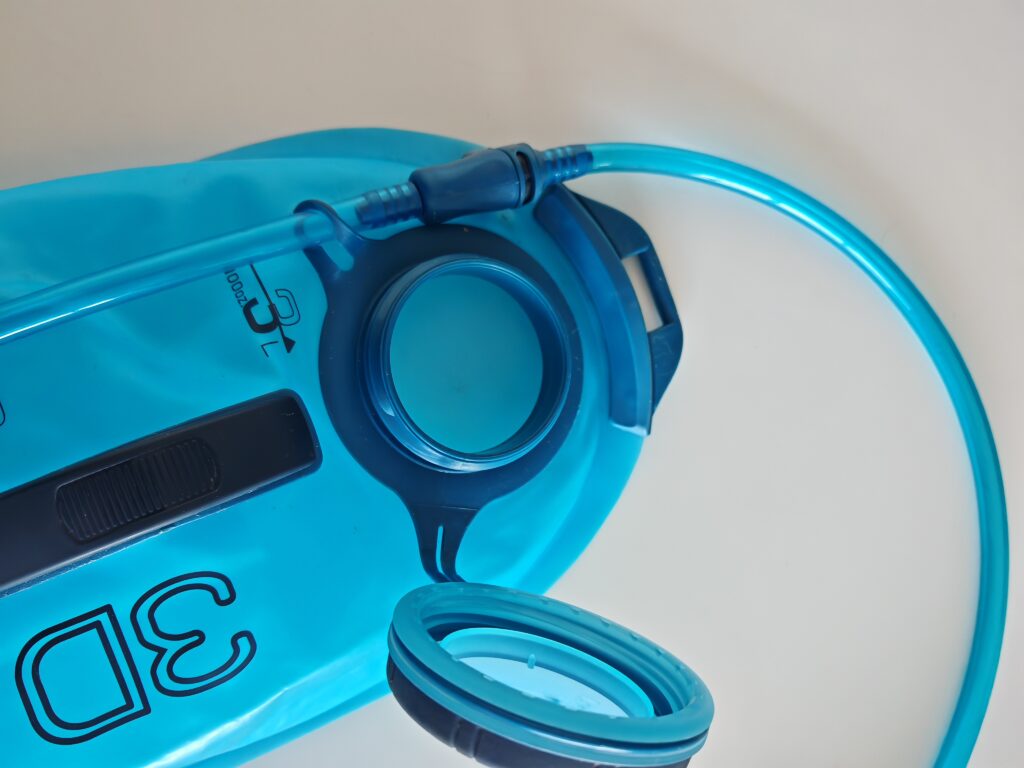
This is the category the whole product is built around, and it’s where the 3D Hydro earns its top rating. The fill opening is a wide screw cap—smaller than the CamelBak Crux’s handle-equipped port, but still wide enough to fill from a tap, filter, or stream without the fiddly small-mouth frustration of older-generation bladders such as the Platypus Hoser. Cleaning is straightforward thanks to the self-supporting shape, which means you can actually get a brush or cloth into the corners, rather than fighting a floppy bag that collapses the moment you let go of it.
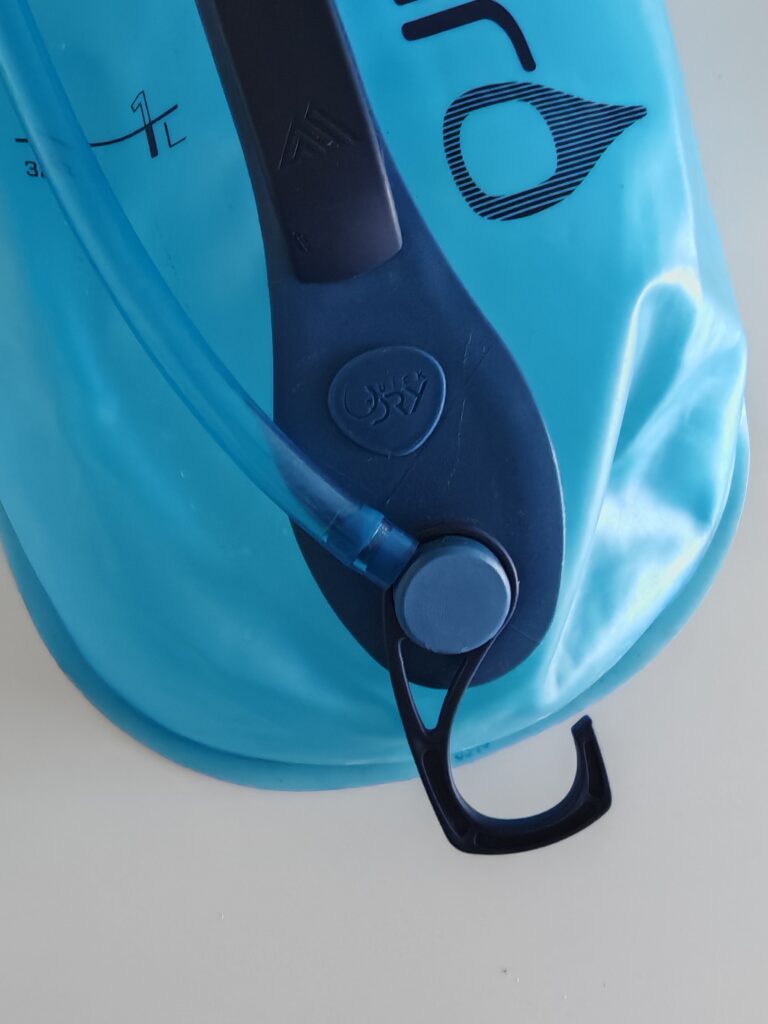
Drying is where the Gregory 3D Hydro 3L Reservoir separates itself from the competitors. When stood upright with the cap off, the 3D Hydro air-dries on its own—no drying rack, no wooden spoon propping the opening, no hanging it from a coat hanger for two days. I tend to hang it upside down from a cupboard handle using the QuickDry hangar over the sink, which effectively dries it. For anyone who’s ever developed a slightly funky-tasting reservoir from incomplete drying, this is a genuinely meaningful upgrade to trail hygiene.
On-Trail Performance
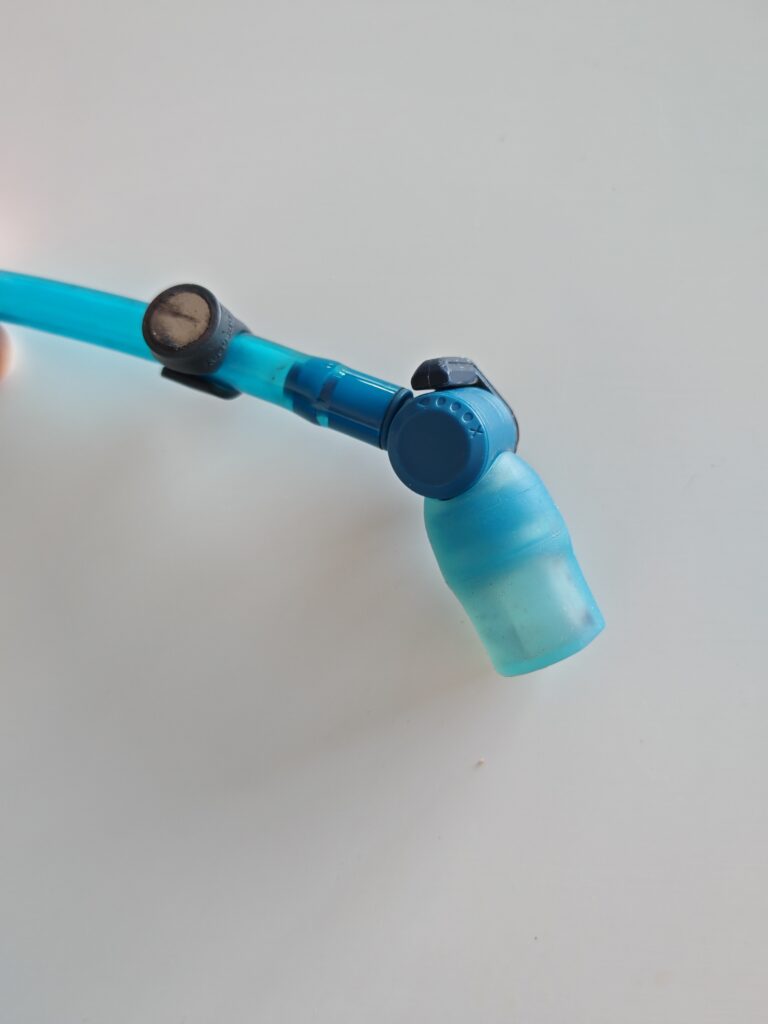
In use, the magnetic DryLock bite valve is the standout convenience feature, and after using an adjustable valve, I wouldn’t go back. It has a firm on/off shut-off that resists accidental leaking in the pack, and the valve delivers a solid, unrestricted flow when open. This means no sucking hard through a pinched or kinked mouthpiece to get water out, which is a genuine annoyance on some competitor bladders and can make hydrating in hot conditions difficult. The magnetic sternum-strap clip easily attaches to the backpack sternum straps that keep the hose pinned to your chest rather than flapping loose, and it disengages easily with one hand when you actually want a drink.
Having the magnetic attachment was a game-changer, and we’ve since got an aftermarket Osprey version for Roisin’s Platypus Hoser. If you’re running a SpeedClip-enabled Gregory pack, the reservoir clips into the hydration sleeve with one motion and disconnects just as easily for refilling on the trail—genuinely useful if you’re topping up mid-hike and don’t want to unthread the entire hose assembly each time. This works on backpacks with another backpack less fluently where the hosing can be unclipped and the reservoir removed for refilling.
One recurring theme across other independent reviews, and something I noticed myself early on: there’s a minor plastic taste on the Gregory 3D Hydro 3L Reservoir when new compared to rivals like the CamelBak Crux or Platypus Hoser. It fades with repeated use and cleaning cycles, so it’s worth giving it a few rinses and cycles before on-trail use.

Durability — The Honest Caveat
This section has some conflicting reviews and user reports, so I’ll talk purely from my perspective. When compared to the soft bladders, it feels more durable with the thicker plastic and rigid body. The Valves and hose can easily handle being routed through backpacks, straps and being scraped on rock when scrambling. I would say the larger screwed opening is fairly reliable but always double-check it’s sealed, as I’ve experienced leakage if the cap is not fully screwed on correctly.
Some reports note major failures of the fill-opening seam after regular use for half a year, but I’ve experienced my old Platypus Hoser leaking at the seam and not had any worries so far. Gregory’s broader catalogue has a strong reputation for build quality, and I’ve happily relied on the Gregory 3D Hydro 3L reservoir in remote Patagonia Treks, hot summer days hiking in Yosemite, and backpacking in British Columbia.
My own Reservoir hasn’t shown any sign of this after 2 years of moderate use, and the overall build quality feels considerably more substantial than a basic budget bladder. I’d recommend inspecting the fill-opening seam periodically, especially before longer trips to check if there are potential leaks.
Weight & Packability
At 198g for the 3L version, the 3D Hydro sits at the heavier end of the category—roughly 60% heavier than a basic slim-profile bladder, and noticeably heavier than most flat-panel competitors once you factor in the rigid structural body that makes the drying performance possible. For day hikes and general backpacking, this is a rounding error and not noticeable. For anyone running an ultralight kit list where every gram is audited, it’s a legitimate consideration, and there are lighter options on the market if weight is your primary metric.
Because the body doesn’t collapse flat the way a standard bladder does, it also takes up marginally more space in a loaded pack when full, though this is a minor factor compared to the weight difference. When flying, I tend to just store it in the Backpack Hydration Sleeve out of the way. If you’re optimising a summit-day pack down to the gram, this isn’t the reservoir for that specific day. For general trail use where convenience matters more than shaving 100g, it’s a sound trade, and the added optional hydration capacity allows you to travel further and faster independently.
Where this equipment earned its keep
I don’t review gear out of a box. Read the full destination guides where the Gregory 3D Hydro 3L Reservoir has been tested in remote Patagonia, Yosemite and on BC backpacking trips.


Gregory 3D Hydro 3L Reservoir: Pros & Cons
✔ PROS
- Self-supporting 3D shape is the best drying solution of any reservoir in this category — genuinely solves the mould/funk problem by allowing air to circulate and dry efficiently without additional drying racks.
- Internal baffle noticeably reduces water sloshing on technical or fast-moving terrain
- Magnetic DryLock bite valve delivers strong, unrestricted flow with a reliable on/off shut-off and holds onto a backpack chest strap securely, allowing easy access and regular on-trail hydration.
- SpeedClip system makes disconnecting and refilling mid-trail genuinely fast on compatible Gregory packs and most other backpacks too. The clip holds the bladder very securely in Gregory backpacks, whereas other toggles and clips can hold the bladder in the internal sleeve.
- EasyGrip Fill Port is a larger opening for quicker refilling, and the Spine Handle allows carrying the reservoir around camp handy, and gives great handling & aim when refilling in streams and taps. It makes refilling quicker than holding a fiddly small aperture bladder.
- QuickDry hanger and self-supporting body mean no drying rack or improvised prop needed
✘ CONS
- At 198g, it’s roughly 60% heavier than a basic flat-slab reservoir — a real consideration for ultralight setups.
- Documented fill-opening seam failures reported after ~6 months of regular use in independent long-term reviews
- Slight plastic taste when new, more pronounced than rivals like CamelBak Crux or Platypus Hoser
- Fill opening is smaller than the CamelBak Crux’s handle-equipped port — slightly less convenient one-handed
- Rigid 3D body takes up marginally more pack space than a flat bladder when full
- While it dries better than flat reservoirs, the area around the fill-port threads can still trap moisture if not angled correctly.
Gregory 3D Hydro 3L Reservoir: Kit Rating
Competitor Comparison
The 3L hydration reservoir category has three genuine benchmarks. Here’s where the 3D Hydro sits against them.
Gregory 3D Hydro 3L Reservoir vs. Platypus Hoser 3L
The Platypus Hoser is lighter, cheaper, and packs down smaller than the Gregory 3D Hydro, making it a popular choice among ultralight hikers. However, its soft construction is more awkward to fill, clean, and dry, with the same fold-and-moisture issues found in many traditional reservoirs. If minimising weight is your top priority, the Hoser is a solid option, but for everyday usability and long-term maintenance, the Gregory 3D Hydro is the better-designed hydration system.
Gregory 3D Hydro 3L Reservoir vs. CamelBak Crux 3L
The Crux is the value benchmark in this category, and it beats the 3D Hydro on two specific fronts: it has a noticeably larger fill opening with an integrated handle that makes filling genuinely one-handed, and it consistently tastes cleaner out of the box across independent testing. Where the 3D Hydro pulls ahead is drying and long-term hygiene — the Crux’s flat, floppy construction has the same fold-and-mould problem as most traditional bladders. If cost and simplicity are your priority, the Crux is the safer buy at a lower price. If you’ve been burned by a mouldy bladder before, the 3D Hydro’s drying advantage is worth the premium.
Gregory 3D Hydro 3L reservoir vs. Osprey Hydraulics 3L
The Hydraulics Reservoir takes a different approach to the same underlying problem: rather than a self-supporting body, it uses a rigid backer plate, which makes it the easiest reservoir to reload into an already-packed overnight bag — a genuine advantage for multi-day backpackers who don’t want to fully unpack to swap a bladder. It’s also slightly heavier than the 3D Hydro. For day hikers and those prioritising drying convenience, the 3D Hydro is the better all-rounder; for overnight backpackers loading and reloading a stuffed pack regularly, the Hydraulics’ structural advantage there is real.
How the Gregory 3D Hydro Compares
| Feature | Gregory 3D Hydro 3L | CamelBak Crux 3L | Osprey Hydraulics 3L | Platypus Hoser 3L |
|---|---|---|---|---|
| Price | $45–50 USD | $42 USD | $50–55 USD | $35–45 USD |
| Weight | 198g / 7 oz | 210–235g / 7.4–8.3 oz | ~230g / 8.1 oz | ~102g / 3.6 oz |
| Fill Opening | Wide screw cap | Huge fill port with handle | Standard screw cap | Slide-lock opening |
| Structure | Self-supporting 3D body | Flat and flexible | Rigid backer plate | Soft ultralight design |
| Best Feature | Fastest drying system | Excellent taste & easy filling | Easiest to load into full packs | Extremely lightweight |
| Known Issue | Heavier than rivals | Valve leaks reported on some units | Bulky in slim daypacks | Harder to clean and dry |
| Best For | Regular hikers & trekkers | Budget-conscious users | Backpackers carrying full loads | Ultralight hikers |
Who Is The Gregory 3D Hydro 3L Reservoir For?
The Gregory 3D Hydro 3L reservoir is ideal for Day hikers and general backpackers who are tired of fighting a floppy bladder for drying and cleaning, and who value low-maintenance gear with a fast-flowing valve, easy refills and a 3L capacity. If you’ve ever let a reservoir sit damp for a week and regretted it, this solves that specific problem better than any comparable product on the market. I mainly use it for summer day hikes for the added hydration capacity and any backpacking trip, as the 3L is great around camp for cooking and cleaning.
However, it’s less suitable for Ultralight backpackers and alpine climbers auditing every gram, who will find lighter, more packable reservoirs elsewhere without the drying convenience. I generally believe this Hydration Bladder can suit most people who aren’t ultralight packers, as the features make it a versatile and easy-to-own bladder.
Gregory 3D Hydro 3L Reservoir Summary
The Gregory 3D Hydro 3L Reservoir solves a genuinely annoying problem — the drying-and-mould cycle that plagues every flat-slab reservoir — with a piece of actual engineering rather than a marketing gimmick. It costs you some weight and, per a handful of documented cases, some long-term durability confidence. For most trail users, that trade is worth making.
If your hydration bladder currently lives in the back of a cupboard with a faint smell you’ve decided to ignore, this is the upgrade. If you’re building a gram-optimised alpine kit and already have a reliable cleaning routine, the standard flat bladder — or the lighter end of the category — remains the more rational choice.
Either way, keep an eye on that fill-opening seam over time. It’s the one known weak point in an otherwise well-considered piece of kit. What’s your favourite hydration reservoir for hiking and Backpacking?
Gregory 3D Hydro 3L ReservoirFAQs
Is the Gregory 3D Hydro 3L Reservoir worth it?
Yes. It combines excellent durability, easy cleaning and a practical filling system, making it one of the best hydration bladders for hikers and backpackers.
How does the Gregory 3D Hydro compare to CamelBak?
The Gregory 3D Hydro is easier to fill and clean, while CamelBak reservoirs are typically slightly lighter. Most hikers will prefer the Gregory’s convenience over CamelBak, Platypus, or other hiking hydration bladders despite the extra weight.
Can you put ice in the Gregory 3D Hydro Reservoir?
Yes. The wide DryLock opening makes it easy to add ice cubes during hot-weather hikes.
Does the Gregory 3D Hydro leak?
In normal use, the reservoir is highly leak-resistant. The DryLock closure and bite valve system have proven reliable on long hikes and multi-day treks. Just be careful with the screw opening, as I’ve not done it up correctly and then had leaking water in my tent and backpack.
Is a 3L hydration bladder too large for hiking?
For full-day hikes, summer trekking and backpacking, a 3L reservoir is often ideal. It reduces refill stops and provides enough water capacity for long stretches between sources.
Is the Gregory 3D Hydro 3L compatible with non-Gregory backpacks?
Yes. The reservoir fits any standard hydration sleeve as a universal-fit bladder. The SpeedClip one-handed mounting system, however, only works with SpeedClip-enabled Gregory packs — on other brands you’ll use it as a standard hang-and-hose reservoir without that specific convenience feature.
What capacities does the Gregory 3D Hydro come in?
The 3D Hydro reservoir is available in 1.5L, 2L, and 3L capacities, allowing you to match reservoir size to trip length and pack volume.
How much does the Gregory 3D Hydro 3L weigh?
The 3L version weighs approximately 198g (7 oz) empty. This is heavier than most flat-slab competitors of the same capacity, a trade-off for the reservoir’s self-supporting, easy-to-dry 3D structure.